


What makes art valuable? 75% context & 85% authenticity
Many believe that art is valuable only because of its price. However, studies show that over 60% of art lovers value emotional resonance more than market value. True art value arises from aesthetic quality, emotional depth, spiritual significance, and cultural context. This article explains how these dimensions interact and how you can consciously choose valuable artworks.
Table of Contents
- Fundamentals: What makes art valuable?
- Emotional and spiritual dimensions of art value
- Cultural context and societal values
- Misconceptions about art value
- Authenticity and meaning in artworks
- Frameworks and mental models for art evaluation
- How to select and experience valuable art
- Frequently asked questions about valuable art
Key Takeaways
| Point | Details |
|---|---|
| Art value is multidimensional | Aesthetics, emotion, spirituality, and culture collectively shape its value. |
| Authenticity increases value | Artist's intention and genuine expression create deeper connections. |
| Price alone is misleading | Emotional and spiritual factors often surpass economic valuations. |
| Cultural context changes perception | Societal frameworks determine which art is considered valuable. |
| Conscious selection requires reflection | Structured evaluation models aid in authentic art choice. |
Fundamentals: What makes art valuable?
Art value consists of two essential components. The intrinsic value of art lies in its ability to convey meaning and purpose that enrich life, independent of external benefits. Extrinsic value arises from market factors such as fame, collector's value, or price.
Historically, the concept of art value evolved from the pure craftsmanship of medieval guilds, through romantic theories of genius, to today's pluralistic view. Modern art theory recognizes that value is subjective and context-dependent. A painting can be priceless to its owner, while finding no buyer on the market.
Meaning-making forms the core of true value. Artworks that convey personal or universal meaning remain in memory and shape identity. These works do not merely serve as decoration but become companions in life.
Intrinsic value is particularly evident in unsellable art. Family portraits, personal sketchbooks, or ritual objects hold immense value for their owners. Their worth stems from memories, emotions, and cultural significance rather than market demand.
Important dimensions of intrinsic art value:
- Ability to create meaning and existential reflection
- Emotional resonance and personal impact
- Spiritual significance and transformative power
- Cultural identity and communal connection
- Aesthetic experience beyond mere beauty
Emotional and spiritual dimensions of art value
Art possesses a strong emotional and spiritual component that enables profound reflections for the viewer. This dimension often transcends the purely aesthetic experience. Neurological studies show that intense art viewing activates brain regions associated with emotion, empathy, and self-reflection.
Emotional resonance occurs when artworks mirror personal experiences or open up new perspectives. An abstract painting can express sorrow that words cannot grasp. A mythological depiction can reveal hidden longings. These moments create connections between the work and the viewer.
Art can lead people to spiritual self-reflection, which increases its value beyond superficial beauty. In Germany and the Netherlands, numerous studies document how art experiences foster spiritual development. Museums report visitors lingering before certain works and experiencing transformative moments.
The connection between art and society shows how collective emotions are expressed through visual language. Artworks become mirrors of societal moods and individual states of mind. This dual function explains why some works endure for generations.
Central emotional and spiritual value factors:
- Activation of deep emotional brain regions through contact with art
- Personal transformation through symbolic imagery
- Spiritual self-knowledge and existential questions
- Empathetic connection between artist and viewer
- Universal themes in individual forms of expression
Pro Tip: Observe your physical reactions when viewing art. A faster heartbeat, goosebumps, or slowed breathing signal emotional resonance. These physical signs help identify authentic connections. Note such moments to understand your preferences more consciously.
The meaning and impact of art unfold especially in conscious moments of contemplation. Art and mindfulness naturally connect when we take the time to truly see a work rather than just look at it.
Cultural context and societal values
Aesthetic experience is strongly influenced by the cultural and social context, which determines which works are perceived as valuable. Art fulfills social functions such as identity formation, communication, and ritual significance. These functions vary considerably between cultures.
In Germany, art lovers traditionally value philosophical depth and craftsmanship. Dutch viewers often appreciate realism and everyday relevance, shaped by the Golden Age of genre painting. These cultural influences affect which artworks emotionally resonate and are perceived as authentic.
Societal influences on art also manifest in themes and symbols. What is spiritually charged in one culture can appear neutral in another. Cultural and spiritual values in art are often difficult to measure, but they significantly shape personal appreciation.
Social change creates new art values. The growing mindfulness movement in Central Europe has increased interest in meditative, symbolic art. Works considered decorative 20 years ago are now valued as spiritual tools.
| Culture Type | Aesthetic Preference | Spiritual Appreciation | Main Function |
|---|---|---|---|
| Traditional European | Realism, Craftsmanship | Religious Symbolism | Identity Formation |
| Modern Urban | Abstraction, Minimalism | Personal Spirituality | Self-Expression |
| Philosophically Oriented | Conceptual Art, Symbolism | Existential Questions | Reflection |
| Environmentally Conscious | Nature Motifs, Sustainability | Connection to Nature | Awareness |
The table shows how different cultural frameworks shape art perception. Conscious spaces and the impact of art are closely linked, as cultural expectations determine which art is appropriate in which spaces.
Cultural influencing factors on art value:
- Historical art traditions of the region
- Societal norms and taboos
- Religious and spiritual influences
- Education systems and art mediation
- Contemporary social movements
Misconceptions about art value
A common misconception is that art is defined solely by its economic price; in reality, however, emotion, meaning-making, and cultural significance are central value factors. This misunderstanding arises from media focus on auction records and collector values.
Another fallacy is that aesthetics alone define art value. Beauty is subjective and culturally shaped. A technically perfect work without emotional depth often remains cold. Conversely, seemingly "unbeautiful" works can possess immense value due to their expressive power.
Many mistakenly view art as mere decoration without deeper meaning. This perspective ignores the transformative power of authentic artworks. Decoration beautifies spaces; art transforms consciousness. The difference lies in intention and depth.
The misconception that only famous artists create valuable works prevents many from discovering meaningful art. Emerging artists often produce emotionally more honest works than established names. Emotional significance arises independently of reputation.
Typical evaluation errors and their corrections:
- Error: Equating art value with sale price. Correction: Prioritize personal resonance and meaning.
- Error: Confusing complexity with quality. Correction: Evaluate the authenticity of expression, not technical sophistication.
- Error: Blindly following trends. Correction: Use your own emotional reactions as a compass.
- Error: Viewing art in isolation from its context. Correction: Include cultural and personal layers of meaning.
- Error: Seeing expertise as a prerequisite. Correction: Accept openness and reflection as avenues of access.
Pro Tip: Ask yourself three questions for every artwork: What do I feel? What do I think? What do I remember? These dimensions capture emotional, intellectual, and personal resonance. Artworks that address all three areas are likely to hold high value for you, regardless of market prices.
Authenticity and meaning in artworks
Authentic artworks are characterized by the artist's profound intentions and their ability to connect universal themes with personal expression. Artist's intention makes the difference between mechanical reproduction and meaningful creation.
Authenticity manifests in coherence between form and content. A work about isolation, rendered in cold colors and fragmented forms, appears consistent. Authenticity also arises from the courage to be vulnerable. Artists who share personal truths create works with resonant power.

Universal themes such as love, loss, search, and transformation touch people across cultures. When artists refract these themes through their individual lens, works with multiple layers of meaning emerge. The viewer finds both collective and personal points of connection.
Qualitative studies on art experience show that intense contact with authentic works often triggers transformative moments. Visitors describe feelings of connection, insight, or emotional catharsis. These experiences rarely arise from works that primarily follow commercial trends.
Artistic inspiration and authentic expression correlate strongly. Artists who create out of inner necessity produce works with higher emotional authenticity. This authenticity transfers to the viewer and increases perceived value.
Characteristics of authentic artworks:
- Coherence between artistic intention and visual execution
- Courage for personal, vulnerable expression
- Connection of universal themes with individual perspective
- Avoidance of purely commercial adaptation
- Invitation to interpretation instead of didactic guidelines
Meaning and authenticity in art reinforce each other. Authentic works invite deeper engagement, thereby increasing their meaning. This process makes art a living dialogue instead of passive consumption.
Frameworks and mental models for art evaluation
A four-dimensional evaluation model helps to systematically grasp art value. The four dimensions are aesthetics, emotion, spirituality, and culture. Each dimension contributes independently, but their interaction creates overall value.
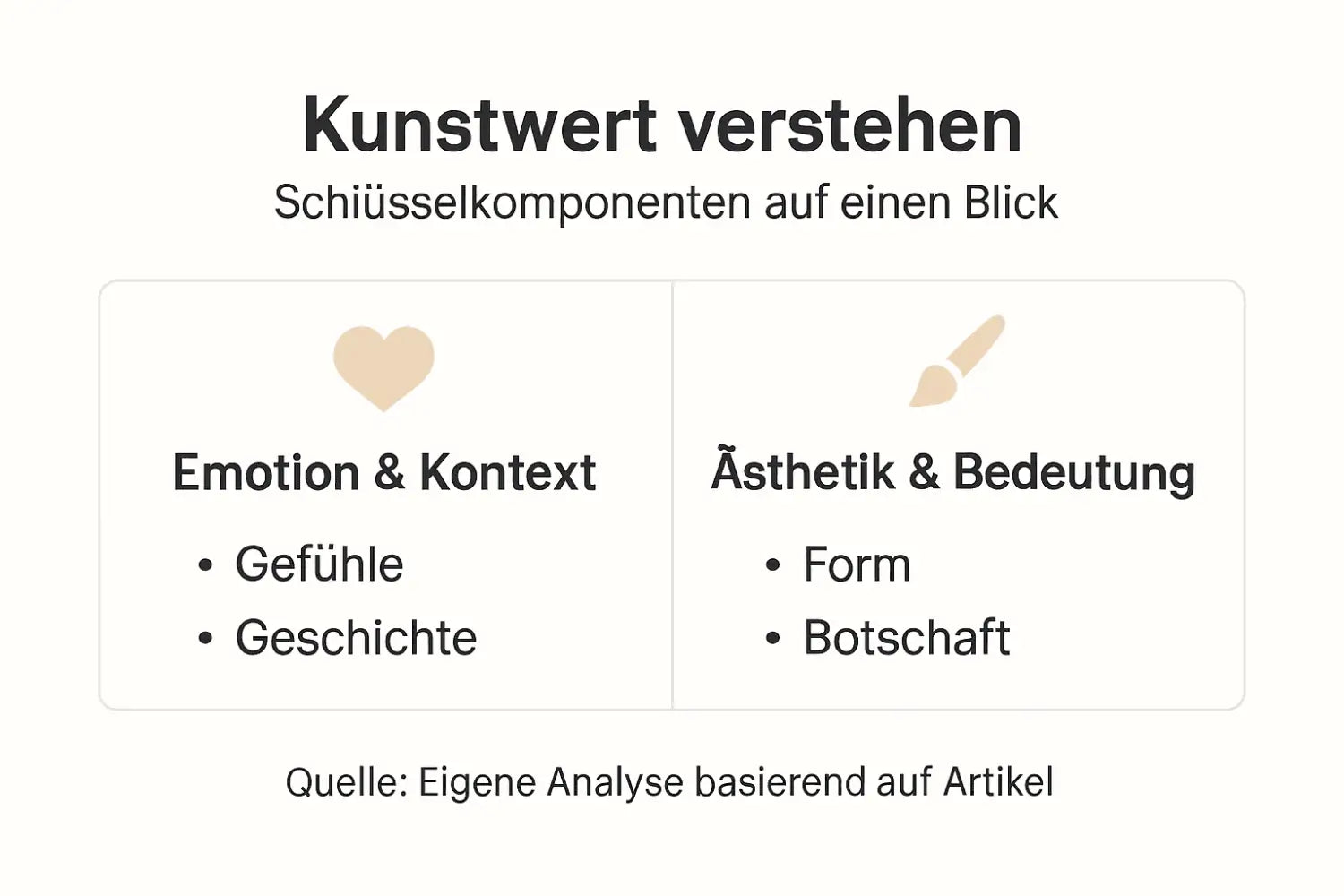
Aesthetics encompasses formal qualities such as composition, color harmony, and technical execution. This dimension is the most objectively assessable, yet cultural influences significantly impact aesthetic judgments. What is considered harmonious in one tradition may appear boring in another.
Emotion describes the work's ability to evoke feelings and create emotional connections. This dimension is highly subjective but central to personal appreciation. Works without emotional resonance remain cold, regardless of aesthetic perfection.
Spirituality captures symbolic depth, existential themes, and transformative potential. Not all art needs to be spiritual, but for viewers with spiritual interests, this dimension significantly increases its value. Spiritual art invites contemplation and self-reflection.
Culture assesses relevance, contemporary reference, and societal significance. A work can be culturally important without being personally moving. Conversely, personally valuable works can be culturally peripheral. Both perspectives are valid.
| Dimension | Key Characteristics | Assessment Focus |
|---|---|---|
| Aesthetics | Composition, technique, harmony | Formal quality and visual balance |
| Emotion | Resonance, empathy, mood | Ability to evoke feelings |
| Spirituality | Symbolism, depth, transformation | Potential for self-reflection |
| Culture | Context, relevance, contemporary reference | Societal significance |
Systematic analyses using this framework make subjective perceptions more conscious. They do not replace intuitive reaction but complement it. Through structured observation, you recognize which dimensions are personally important to you.
Art valuation becomes more transparent and communicable through mental models. Gallerists and collectors use similar frameworks to justify decisions. For individuals, the model helps articulate preferences and search more purposefully.
How to choose and experience valuable art
The subjective perception of art is significantly shaped by individual emotions, personal experiences, and spiritual concerns. This subjectivity is not a weakness but a strength. It enables authentic relationships with artworks.
Conscious art selection begins with self-reflection. What themes move you? What colors and forms attract you? What emotional qualities do you seek in your spaces? Honest answers to these questions create clarity about your authentic preferences.
Context plays a central role in art purchasing. A work for a bedroom should possess different qualities than one for a workspace. Conscious spaces are created through careful selection of suitable art.
Steps to conscious art selection:
- Self-reflection: Identify your aesthetic preferences and emotional needs by looking at various works.
- Define context: Determine the purpose and atmosphere of the room where the work will hang.
- Check authenticity: Research artist intention and work story to distinguish genuine expression from commercial mass-produced goods.
- Test emotional resonance: Spend time with the work before buying; true connections deepen with repeated viewing.
- Plan integration: Consider how the work harmonizes with existing furnishings without compromising your authentic choice.
Pro tip: Use the 24-hour rule for art purchases. If a work truly moves you, you'll still be thinking about it the next day. Spontaneous purchases are often based on superficial appeal. True connections outlast the initial encounter and grow over time.
Art buying tips help to understand technical aspects such as print quality and framing. But the most important decision remains emotional. Buy art that moves you, not what might impress others.
Emotional resonance also includes spiritual openness. Let works affect you without rushing to interpret. Sometimes meaning only reveals itself after weeks or months of living with a work of art.
Avoid common evaluation errors through conscious practice. Don't ask "Is this good art?", but "Is this good art for me?". This shift frees you from external standards and enables authentic decisions.
Discover valuable art prints at Curiocanvas
At Curiocanvas, you will find carefully curated art prints that combine aesthetic quality with emotional depth. Every work in our collection has been selected according to the principles described in this article: authenticity, spiritual resonance, and symbolic meaning.
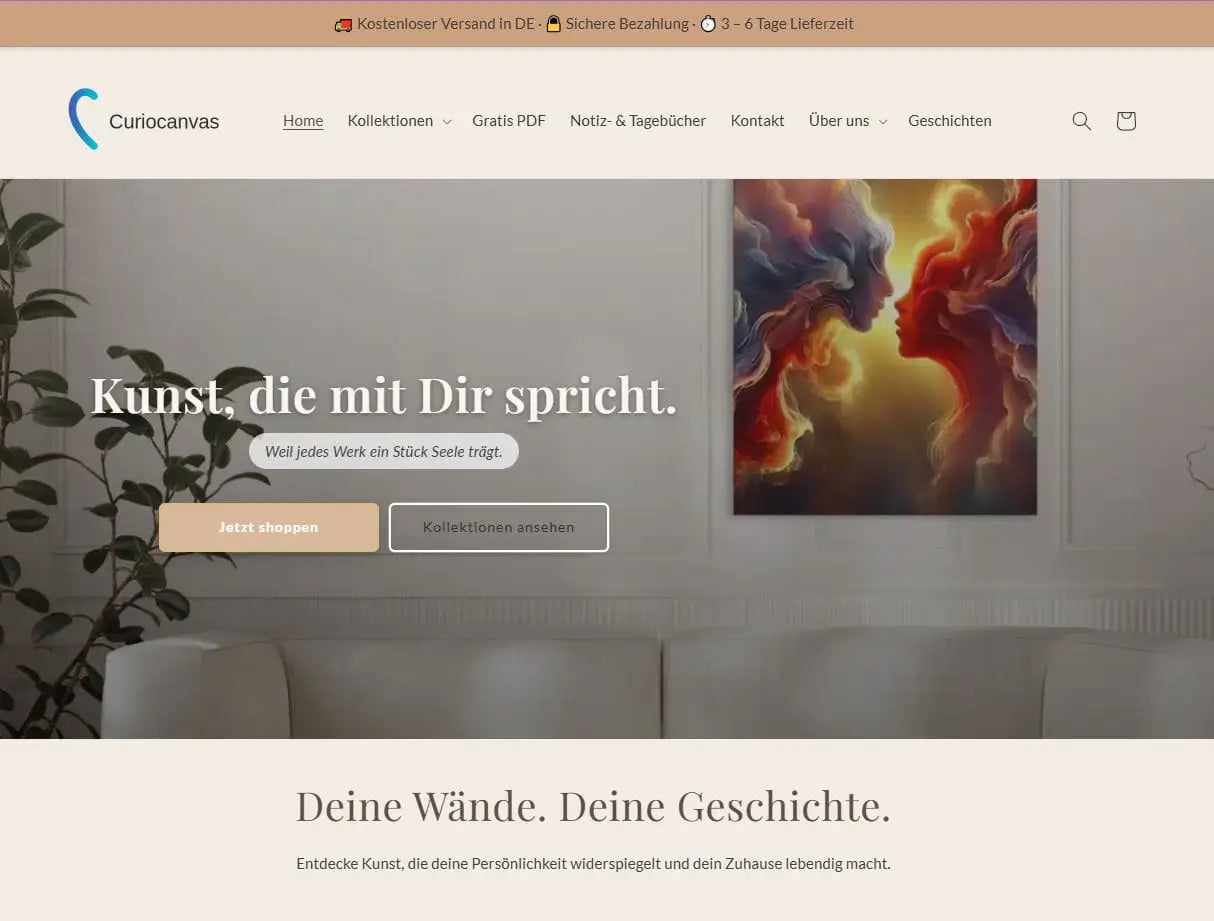
Our high-quality art prints are created using first-class print-on-demand technology that guarantees color fidelity and longevity. From meditative abstractions to mythologically inspired motifs, we offer variety for different spiritual needs and room concepts.
Understand the types and meaning of art prints to choose the ideal medium for your vision. Our guides help you make informed decisions. Discover why canvas pictures hold a special quality for art lovers.
Curiocanvas combines poetic vision with practical accessibility. Transform your walls into meaningful spaces that reflect your inner journey.
Frequently asked questions about valuable art
What does the intrinsic value of art mean?
Intrinsic value refers to the meaning and significance that art offers independently of economic aspects. This value enriches life through emotional touch, spiritual reflection, and aesthetic experience. It exists for the viewer themselves, not for the market.
How do I recognize the spiritual meaning of a work of art?
Pay attention to symbolism, universal themes, and your personal connection when viewing. Spiritual meaning often manifests in emotional shifts, deepened thoughts, or a feeling of connection. Works with a spiritual dimension invite repeated contemplation.
Why is authenticity crucial when buying art?
Authenticity ensures that the artwork carries genuine feelings and messages instead of commercial formulas. It significantly strengthens the emotional bond between the work and the viewer. Authentic art grows in meaning over time, while superficial trends quickly fade.
How does culture influence the perception of art?
Cultural conditioning determines how artworks are perceived, interpreted, and evaluated. It fundamentally influences aesthetic preferences, symbolic meanings, and emotional reactions. What is spiritually charged in one culture may seem neutral or incomprehensible in another.
Can everyone experience art as valuable, even without expert knowledge?
Yes, appreciation is primarily based on personal experience rather than academic knowledge. Openness to emotional reactions and a willingness to reflect foster authentic art experiences more effectively than theoretical expertise. Understanding the meaning of art happens through encounter, not through study.
Recommendation
- Art and Society – How images transform spaces and people – Curiocanvas
- What makes art high-quality? Emotion and quality combined. – Curiocanvas
- Art and Conscious Spaces – Impact on soul and space – Curiocanvas
- What is modern wall art – More than decoration – Curiocanvas
- Authenticity of reviews - YourPowerFoods.com
- What Is Punk Art and Why It Matters – The Mansion Press