


Art and conscious spaces – their effect on soul and space
A carefully selected work of art can fundamentally transform a room and noticeably enhance its atmosphere. For many art lovers in Germany and the Benelux countries, conscious interior design begins where art intersects with personal perception. According to Susanne Rau, space is a social construct that carries cultural meanings and creates emotional resonance. This approach opens up fascinating possibilities for consciously creating vibrant, inspiring environments with art.
Table of contents
- Art and conscious spaces: Definition and concepts
- Types of conscious spatial design with art
- Emotional and aesthetic impact in the room
- Practical implementation: selection, placement and style
- Avoiding mistakes: Risks in spatial art and alternatives
Key findings
| Point | Details |
|---|---|
| Conscious spaces | Spaces should be consciously designed to evoke emotional and spiritual resonance. The selection of artworks plays a central role in this process. |
| Art as Transformation | Art is not only decorative, but also a tool for transformation that can promote emotional well-being and self-reflection. |
| Emotional architecture | Every work of art has an emotional frequency that influences the mood of a room. The deliberate selection and placement of art offers profound emotional experiences. |
| Flexibility in design | There are various approaches to interior design with art. The choice depends on personal goals, the size of the room, and the desired emotional effect. |
Art and conscious spaces: Definition and concepts
Art and conscious spaces form a unity – not as separate things, but as an interwoven experience. When you enter a room where a meaningful work of art hangs, something subtle happens: the air seems thicker, time slows down, your attention sharpens.
Conscious spaces are places intentionally designed to create emotional and spiritual resonance. They don't arise by chance – they result from conscious decisions about which objects, colors, shapes, and energies we integrate into our environment.
Art in this context is not merely decoration. It is a tool of transformation . It speaks to your soul, not your mind. A well-placed painting can alter your emotional well-being, shift your perspective, or invite you to deeper self-reflection.
The philosophical foundations
For a long time, space was understood as a mere physical quantity – simply square meters filled with furniture. This has changed. In her research, Susanne Rau describes space as a social construct that interweaves perception, culture, and meaning.
For consciously designed spaces, this means: space is not neutral. Every corner possesses a quality. Every empty wall awaits dialogue.
How art structures spaces
The Bavarian Academy of Fine Arts has documented that since the 19th century, art has been understood as a shaping factor – not as an object that fills a space, but as a force that actively creates it.
Specifically, this means:
- Art structures the gaze and directs attention.
- It creates emotional resonance and personal encounters.
- She transforms empty walls into spaces of meaning.
- It affects your nervous system, often unconsciously.
The difference between decoration and deliberate artistic design
A poster from a mass-produced catalog? That's decoration. A carefully selected work of art that reflects your inner world or challenges you? That's conscious interior design.
Conscious spaces emerge when you ask yourself: What do I want to feel when I enter this space? What inner transformation do I want to support? What story does my environment want to tell?
Conscious spaces are not beautiful for others – they are meaningful for you.
The emotional architecture
Every work of art has an emotional frequency . Abstract forms have a different effect than figurative works. Warm colors evoke different feelings than cool tones. A mythological symbol resonates differently than a geometric form.
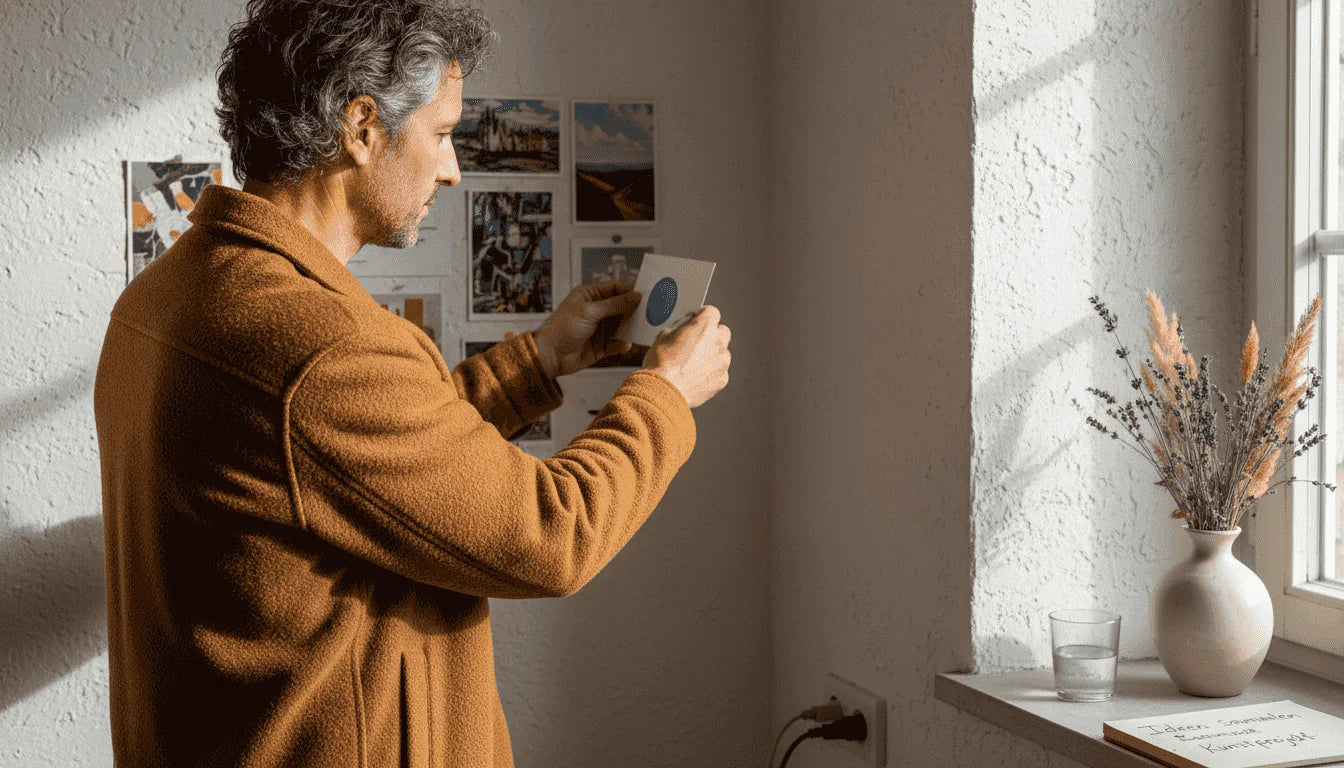
If you ignore this emotional aspect, your space will remain silent. If you understand it, your living room will become a place of quiet transformation .
Concepts for your practice
Conscious interior design with art works on several levels:
- Visual level : colors, shapes, composition
- Emotional level : What feelings will the work evoke in you?
- Spiritual level : Does the work contain symbolism that resonates with your inner search?
- Sensory level : How does the room feel when you enter it?
These levels work together. None of them function in isolation.
Pro tip: Start by choosing a room and asking yourself: “How do I want to feel here?” Let this question become the basis for every art selection – not trends, not Instagram aesthetics, but genuine emotional resonance.
Types of conscious spatial design with art
There is no single way to consciously design a space with art. Depending on what you want to achieve, what space you have available, and what emotional effect you are aiming for, different approaches will work.
The different types of artistic spatial design show you how diverse the possibilities are – from permanently integrated works to temporary, changeable interventions.
Architecture-related art – permanent in space
Art related to architecture is closely linked to the spatial structure. It does not arise as an addition, but as an integral part of the space itself.
Think of a large-scale mural that completely alters the proportions of the room. Or an installation that plays with the room's lighting conditions. These works are permanent, have a lasting impact on the space, and require careful planning.
- They have a direct effect on spatial perception
- They address architecture and transform it.
- They require commitment – it's not a quick change.
Autonomous and site-specific objects – present, but independent
These works are independent art objects that are deliberately placed in a space – but they are not merged with the architecture.
A carefully placed painting , a sculpture, a symbolic object. They have their own power, but can also be exchanged. They create focal points and invite dialogue.
- They are more flexible than architecture-related works.
- You can change the emotional atmosphere of a room.
- They allow experimentation without long-term commitment.
Performative and temporary interventions – art that sets processes in motion
Not all deliberate spatial design is static. Performative interventions are art actions that take place in the space – a dance, a sound installation, a time-limited intervention.
Temporary works encourage active participation . They not only change the physical space, but also the social dynamics that emerge within it.
This format works particularly well if you:
- You want to transform a room for a specific period of time
- you want to involve people in a process
- If you want to try something experimental without making a long-term commitment
Image- and action-oriented spatial concepts – your personal approach
Artistic approaches to spatial design also include choreographic and museum concepts – spaces designed as a sequence that the viewer traverses.
You can think of your living space as a silent exhibition : Each work of art follows an inner logic, creates transitions, tells a story from the entrance to the most intimate retreat.
Conscious interior design with art is always a personal choice – what works for your soul may not work for others.
How to choose your type
Ask yourself: How much time do I have? How committed do I want to be? What emotional depth do I need? Should the space be dynamic or stable?
Your answers will naturally lead you to the type that suits you.
The different types of conscious spatial art can be clearly distinguished based on their characteristics:
| Type of room design | durability | Changeability | Typical use case |
|---|---|---|---|
| Architecture-related art | In the long term | Small amount | Overall effect, permanent installations |
| Autonomous, site-specific objects | In the medium term | Medium | Flexible focus points, exchange possible |
| Performative Interventions | Short term | High | Temporary promotions, events |
| Image/action-related concepts | Variable | Medium to high | Individual paths, exhibitions |
Pro tip: Start with autonomous objects – a high-quality art print or a sculpture – to feel how a room reacts to this new visual impulse before committing to permanent interventions.
Emotional and aesthetic impact in the room
Art doesn't just affect your eyes – it affects your entire presence. When you enter a room with consciously chosen art, your breathing, your muscle tension, your inner frequency all change.
This is not an exaggeration. This is neuroscience and aesthetic experience at the same time.
How art reaches your senses
Artistic spatial design creates dynamic experiences that are not static – they appeal to your senses and create a real spatial effect.
This means: Colors influence your psyche. Shapes guide your gaze. Symbols activate unconscious memories. None of this is accidental.
The emotional impact of art works on several levels simultaneously:
Below is an overview of how artistic means affect the emotional experience in a space:
| Artistic element | Effect on the senses | Potential emotional resonance |
|---|---|---|
| Color | Stimulates visual processing | Peace, energy, security |
| form | Directs attention, movement | Tension, harmony, stability |
| symbol | Activates memories | Identification, inspiration |
| composition | Structured visual guidance | Order, openness, intimacy |
- Visually : Colors, lines, composition directly appeal to your eye.
- Physically : Your nervous system reacts before your mind analyzes the work.
- On a psychological level : Symbols and meanings resonate with your inner world.
- Spatially : The work changes how you perceive the space itself.
The meaningful experience
When art truly works, it creates what is called a meaningful experience – a moment when form, feeling, and meaning coincide.
You'll notice it when you pause. When your thoughts become still. When something inside you responds.
True aesthetic impact is not about taste – it is resonance. It is a dialogue between you and the work.
How colors affect emotions
Colors are feelings in visual form. A warm ochre is calming in a different way than a deep blue. A vibrant red activates your nervous system in a different way than a delicate green.
Emotional resonance is created by choosing sensual and meaningful elements that touch on your personal story.
That's why there's no universal color effect – there's only your effect:
- What triggers my inner peace?
- What colors have historically symbolized security or joy for me?
- What emotional states do I want to support in this space?
Space as an inner state
Your living room is not just a physical place. It is also a state of your consciousness.
When the art in a room speaks to you, that room becomes a place of inner presence . You come home, not just physically, but also to yourself.
That is the deep goal of conscious interior design with art – that the space brings you back to your best version of yourself.
What makes a selection aesthetically correct?
There is no objective correctness. There is only your inner truth.
A selection is aesthetically correct if:
- You don't have to explain them – you feel them.
- It doesn't separate, but unites – you with the space, with yourself.
- It leads you a little more home each day
Pro tip: Stand in front of a work of art and pay attention: Does my breathing deepen? Does my neck relax? Does my curiosity awaken? If so – that's your body telling you that this art is right for your space.
Practical implementation: selection, placement and style
Theory is nice – but how do you actually choose? How do you hang it? Which style suits your space and your soul?
This is where things get concrete. This is where awareness becomes action.
Step 1: Choosing the right art
Choosing art isn't about rational thought—it's about emotional intuition. You won't systematically find the best art. You'll recognize it when it calls to you.
Ask yourself these questions:
- Do I feel immediately drawn to this work, or do I have to persuade myself?
- Does this artwork fit a person I want to be?
- Will this work still speak to me in a year, or is it just a trend?
- Can I imagine seeing this artwork every day?
Practical aspects of room design, such as selection and placement , show that conscious decisions determine the transformation of your spatial perception.
Step 2: The correct placement
Where a work of art hangs changes everything – the effect, the emotional resonance, even the meaning of the work itself.
There is no universal rule. But there are principles:
- Eye level as standard : The center of the artwork should hang at eye level (approx. 150-160 cm from the floor).
- Use the negative wall technique : Hang artwork on walls that are visible when you enter the room.
- Let the space breathe : Surround the artwork with air – not everything should be crowded.
- Pay attention to your line of sight : Where do you look when you're sitting? That's where you should focus your attention.
The best placement is the one your eye naturally seeks when you enter a room.
Step 3: Style and Harmony
Style is not decoration – it's consistency. It's an inner logic that holds your space together.
Minimalist spaces require different artwork than maximalist ones. A quiet, monochromatic room has different needs than a colorful space.
This doesn't mean that everything has to "match." It means that it should be visually and emotionally right .
- Does the color of the artwork harmonize with your wall colors?
- Does the energy of the artwork match the energy of the space?
- Does the piece speak the same “language” as your other furniture and objects?
Consciously selecting and designing the environment means that intention, context, and aesthetic harmony work together.
Your personal process
The best method is experimental. Don't buy impulsively, but don't rely solely on your intellect either.
Give yourself time. When you live with a work of art, your relationship to it changes – it grows with you.
Pro tip: Hang the new artwork temporarily – using masking tape instead of nails – and observe it for a week from different positions, at different times of day and in different lighting conditions before making a permanent decision.
Avoiding mistakes: Risks in spatial art and alternatives
Conscious interior design with art can also go wrong. A piece of art that doesn't fit can overwhelm a room instead of liberating it. A wrong choice can slow you down daily instead of inspiring you.
Here are the most common mistakes – and how to avoid them.
Error 1: Ignoring context
You see a beautiful work of art and buy it immediately. But your room is not the gallery space where you saw it.
Light, wall color, room proportions, the people who live here – everything changes. The artwork that shone in a minimalist white box can look lost in your warm, crowded living room.
Mistakes arise from a lack of participation or a lack of consideration of context, which diminishes the impact and acceptance of spatial art.
Mistake 2: Aesthetic overload
Less is often more. If you fill your entire room with artwork all at once, chaos will result instead of harmony.
Your eyes need rest. Your mind needs breathing room. An empty space is not flawed – it is conscious.
Start with one piece. Live with it. Then add more when the space craves it.
Mistake 3: Ignoring your own voice
Trends are tempting. But the Instagram look that's popular right now could seem tacky in a year.
Truly conscious spaces speak your inner truth – not the truth of others:
- Don't follow trends, follow your feelings.
- Don't buy it just because others think it's great.
- Don't let yourself be guided by expectations that are not yours.
A work of art that doesn't speak to your soul is a permanent flaw in your space.
Alternatives to permanent solutions
If you're unsure, use flexible approaches :
- Temporary interventions : Hang artworks with masking tape, not nails. Experiment.
- Rental models : Some galleries offer rental programs. You live with the art before you buy it.
- Participatory processes : Invite friends to take a look at the space. Dialogue instead of isolation.
- Changing exhibitions : Rotate your works. Spaces change, and that's a good thing.
Understanding art as a social space enables encounters and dialogue that create sustainable and emotionally impactful spaces.
The right mentality
Spatial art is a process, not a destination. Your space will change because you change.
Mistakes aren't bad – they're information. They show you what your soul needs and what it doesn't.
Pro tip: Document your room changes photographically over weeks and months – you will recognize patterns in which artworks lift your mood and which distract or stress you.
Bring your spaces to life through conscious art.
The challenge of conscious interior design lies in not just filling spaces, but imbuing them with emotional depth and spiritual resonance. You want to create a space that is more than mere decoration – a place that speaks to your soul and makes your inner world visible. The artwork in your living space should facilitate transformation and give your surroundings a meaningful voice. These are central concerns described in our article “Art and Conscious Spaces – Impact on Soul and Space,” and this is precisely where Curiocanvas comes in.
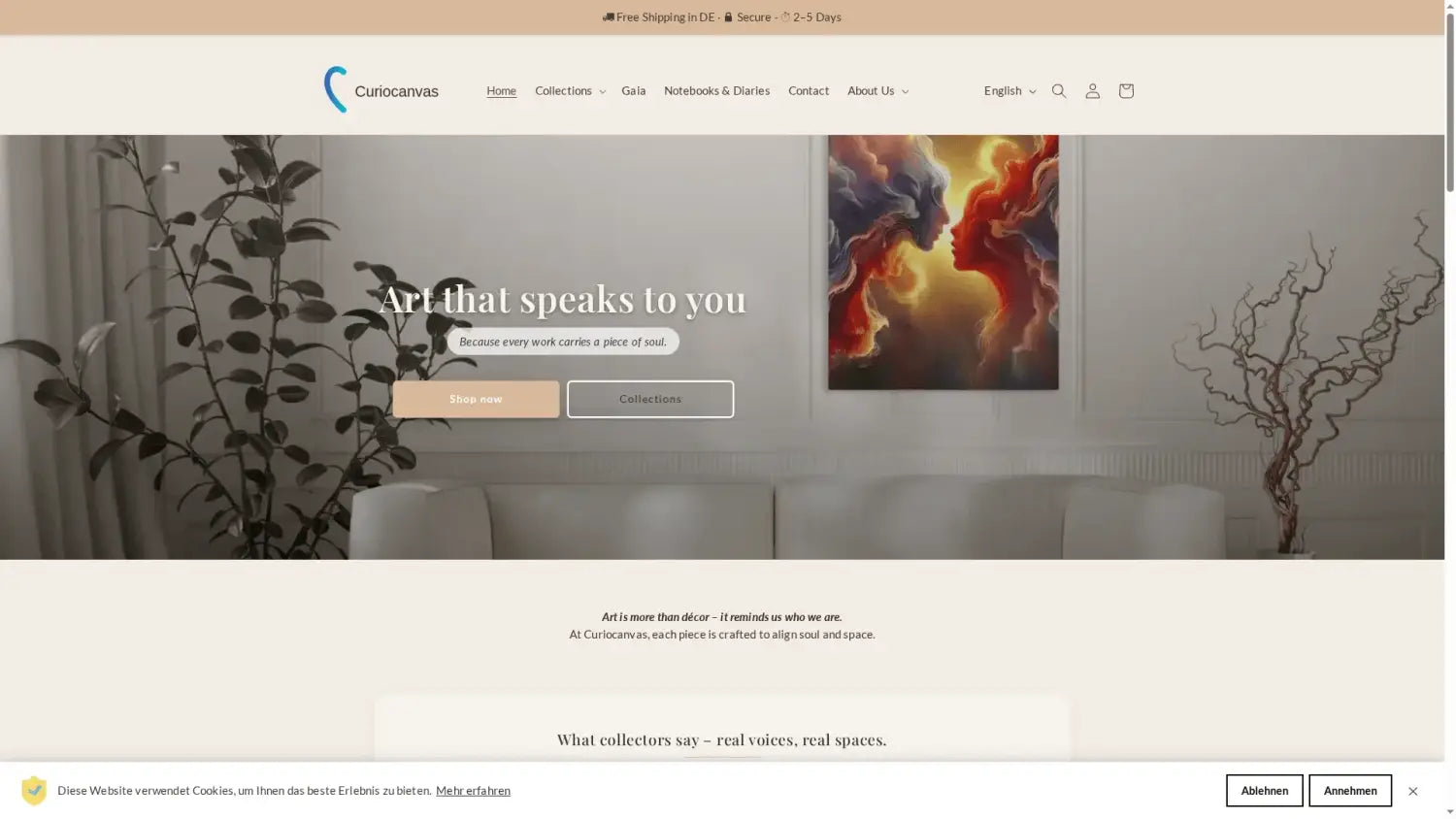
Discover exquisitely designed artworks at curiocanvas.de that, through their poetic, symbolic, and spiritual power, transform your spaces into conscious sanctuaries. Our collections combine emotional resonance with minimalist luxury aesthetics, allowing you to choose wall art that tells your personal story and touches your senses. Be inspired and begin your journey of conscious interior design now with meaningful artworks from Curiocanvas. Create spaces that are not only visible but also tangible.
Frequently Asked Questions
How does art influence emotional well-being in a room?
Art has the ability to generate emotional resonance and influence well-being by opening up new perspectives and encouraging self-reflection.
What are conscious spaces and how do they shape our perception?
Conscious spaces are intentionally designed environments that generate emotional and spiritual resonance, thereby influencing the perception of the users.
What role does the choice of color play in the design of intentional spaces with art?
Colors have a direct effect on the psyche and influence mood. Warm tones can convey a sense of security, while cool colors have a calming effect.
How can I meaningfully arrange my own art collection in my room?
The placement of artworks should be strategic, so that they hang at eye level and are integrated into the overall flow of the room in order to achieve a positive effect.
Recommendation
- Art and Society – How Images Transform Spaces and People – Curiocanvas
- Why Art Has Meaning – Effect on Soul and Space - Curiocanvas
- Consciously experiencing art: A guide to poetically designing spaces – Curiocanvas
- 7 ways to experience the meaning of art in space – Curiocanvas
- Transforming Modern Spaces for Maximum Cleanliness and Durability