


Finding artistic inspiration and shaping it emotionally
Creative people often seek ways to imbue their living spaces with genuine emotional resonance through deep inner inspiration. The conscious connection between art, symbolism, and self-reflection opens up unforeseen possibilities for authentic design. Discover how artistic practice acts as a space for transformative learning , turning your rooms into a personal reflection of your inner journey.
Table of contents
- Step 2: Try out meditative techniques for self-reflection
- Step 3: Explore spiritual symbolism and mythology
- Step 4: Translate inspiration into an artistic form
- Step 5: Check the emotional impact of your art
Quick summary
| Important point | Explanation |
|---|---|
| 1. Practice meditative techniques | Regular breath meditation promotes inner peace and creativity. Use this time to capture spontaneous thoughts. |
| 2. Explore spiritual symbols | Explore symbols and myths that resonate with you to find deeper meanings in your art. |
| 3. Plan the creative implementation | Jot down ideas and sketch spontaneously. Choose a medium you like to make your inspiration visible. |
| 4. Analyze the emotional impact | Observe your artwork over a longer period of time to understand its effect on yourself and others, and to gather feedback. |
| 5. Document the process | Document the development of your art photographically to track your artistic journey and growth. |
…content…
Step 2: Try out meditative techniques for self-reflection
Meditative techniques help you discover your inner feelings and artistic impulses. These practices create space for deep self-awareness, which enriches your creative work.
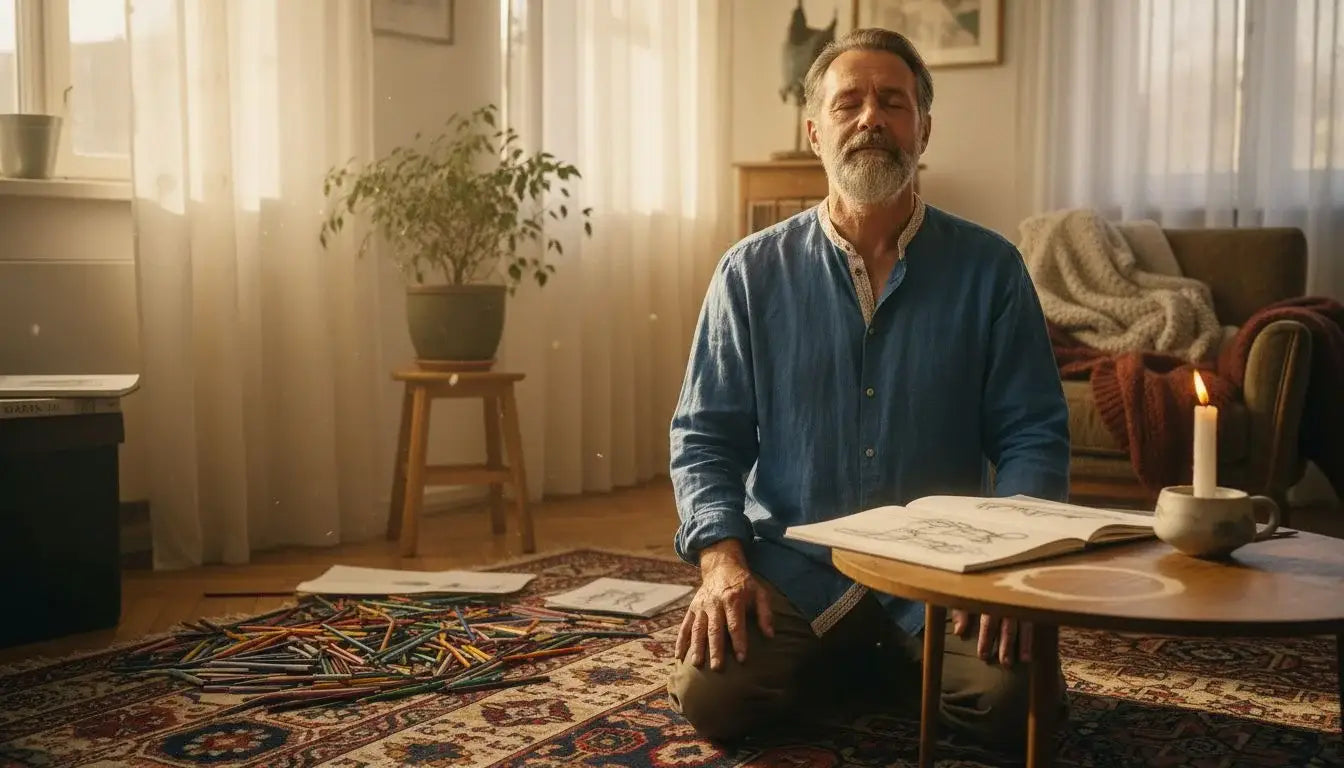
Start by choosing a quiet spot in your living space. A peaceful corner with soft light and perhaps a plant creates the right atmosphere for inner work.
Take some time for a simple breathing meditation . Sit comfortably, close your eyes, and focus on your natural breath. After a few minutes, your mind will become calmer and more receptive to creative insights.
Use this quiet time for guided self-reflection:
- Observe your thoughts without judgment.
- Pay attention to your emotional reactions to your surroundings.
- Explore which colors and shapes attract you.
- Write down any images or words that spontaneously come to mind.
This inner observation is the key to authentic artistic creation. It connects your consciousness with your deeper perceptions.
Using art as a means of self-reflection expands on these practices and shows you how to integrate what you have learned into your visual design.
Repeat these techniques regularly, ideally daily for 5 to 10 minutes. Over time, your sensitivity to inner impulses will grow and be directly reflected in your spaces and creative work.
Here you can see how different meditative techniques affect artistic self-reflection:
| Technology | Primary benefit | Influence on creativity |
|---|---|---|
| Breath meditation | Promotes mental calm | Opens up to intuitive impulses |
| Mental observation | Sharpens self-awareness | Inspiring image associations |
| Emotional mindfulness | Enhances emotional depth | Authentic means of expression |
True artistic inspiration arises not from the hustle and bustle, but from the quiet encounter with yourself.
Pro tip: Create a small meditation ritual that takes place before every creative task. This signals to your mind that it's time for deep concentration and emotional openness.
Step 3: Explore spiritual symbolism and mythology
Spiritual symbolism and mythological motifs possess a profound power to transform your artistic practice. Understanding these elements opens you to levels of meaning that transcend the visual.
Start by exploring mythological figures and symbols that resonate with you personally. Engage with cultures whose stories touch your heart, be it Celtic, Egyptian, or ancient mythology.
Spiritual and mythological traditions permeate artworks with transcendent meaning. Symbols serve as cultural codes that express complex inner truths and help you make your emotional experiences visible.
Explore these dimensions in a targeted way:
- Collect images of symbols that attract you.
- Read myths and note which archetypes appear.
- Connect these symbols to your own life experiences.
- Reflect on which mythological qualities you recognize within yourself.
This conscious connection between myth and self becomes the source of authentic artistic expression. When you understand which symbols speak to you, they can fill your spaces with deeper meaning.
Choose a symbol that particularly fascinates you and explore its history thoroughly. This will enrich your inner understanding and integrate organically into your visual expression.
Symbols are the language of the soul. They connect the visible with the invisible and give your artistic expression spiritual depth.
Pro tip: Hang a piece of art with a personally meaningful symbol in your meditation space. This creates a sacred anchor point that connects your inner work with your outer space.
An overview of the effect of various symbolic and mythical elements in art:
| element | Meaning in art | Effect on the viewer |
|---|---|---|
| Mythological figure | Conveys archetypes | It evokes collective associations |
| Spiritual symbol | Displays transcendental values | Creates deeper emotional resonance |
| Cultural motif | Represents origin | Builds a connection to traditions |
Step 4: Translate inspiration into an artistic form
The transformation of inner inspiration into visible artistic form is the core of your creative journey. Here you connect your emotional insights with concrete creative action.
Begin by gathering your thoughts and feelings from the previous steps. Spontaneously write down the images, colors, and shapes that come to mind, without judgment.
Artistic creative practices open up experiential spaces for transformative learning and foster alternative thinking. A structured process helps you to creatively translate complex inner experiences.
Follow this practical three-step procedure:
- Collect - Jot down bullet points, quickly sketch, photograph inspiring details from your everyday life
- Connecting - Look for patterns between your notes and identify which themes recur.
- Implementation - Choose a medium that feels natural, whether collage, painting, photography or installation.
You don't need to express yourself perfectly. The process itself is more important than the result. Your first attempt will show you which direction your next work should take.
Choose a small project to start with. Perhaps a piece of art that transforms your living room, or a wall design that conveys your spiritual message. This will give your inspiration a concrete form.
Inspiration becomes power when it reaches your body and hands and creates something tangible.
Pro tip: Document your creative process photographically, not just the final result. These images of the process will later show you how organically your artistic vision grows.
Step 5: Check the emotional impact of your art
Your artwork is finished. Now it's time to consciously explore its emotional impact and understand what it evokes in you and others.
Take at least a week before critically reviewing your work. Distance creates clarity and allows you to become more objective.
Sit down and look at your artwork for longer than usual. Emotions are perceived more subtly and intensely with prolonged viewing , which helps you discover its deeper emotional message.
Collect your observations systematically:
- What feelings arise in the first 30 seconds?
- What emotions emerge after 5 to 10 minutes of viewing?
- Which colors or shapes trigger specific reactions?
- Does the work feel authentic to your inner message?
Ask other people to look at your work as well. Their spontaneous reactions will give you valuable feedback about the actual emotional impact . What you intended to express and what is received may be different.
Note which moments or details resonate most strongly with you and others. These insights will show you where your artistic authenticity is most powerful.
If needed, consider adjustments. Sometimes a small change is enough to enhance the emotional impact.
The emotional depth of your art is not revealed at first glance, but through patient, repeated encounters with the work.
Pro tip: Document your emotional reactions in an art journal. These notes will help you recognize patterns in your artistic expression and shape it more consciously.
Discover your artistic inspiration with Curiocanvas
Your journey to artistic self-reflection and emotional expression needs the right visual support. If you're looking for art that transcends mere decoration and makes your inner impulses, spiritual symbolism, and emotional depth tangible, you'll find exactly that with us. Our carefully curated wall art gallery, Flames Kisses Time and Compass – Curiocanvas, combines poetry and symbolism to transform your spaces into meaningful places of inspiration.
Let yourself be inspired by artworks that reflect your feelings and express your personal mythology. Complement your artistic practice with our Poetic Notebooks for Thoughts and Dreams – Curiocanvas – to capture your creative insights for lasting impact. Start now and make your inner life visible with extraordinary art from Curiocanvas . Unfold your soul through art that tells a story, touches you, and transforms you.
Frequently Asked Questions
How do I find artistic inspiration for my work?
To find artistic inspiration, start with meditative techniques for self-reflection. Take 5 to 10 minutes each day to meditate in a quiet space and observe your inner thoughts and emotional reactions.
What meditative techniques can I try to boost my creativity?
You can practice breath meditation, mental observation, and emotional mindfulness. Sit in a quiet place, observe your emotions, and let images or words arise intuitively.
How do I artistically translate my emotional inspiration?
Gather your thoughts and feelings by spontaneously sketching or jotting down whatever comes to mind. Look for recurring patterns in your notes and then choose a suitable medium to realize your ideas.
How do I assess the emotional impact of my artwork?
After at least a week, critically examine your artwork and observe your own reactions and those of other viewers. Note which emotions arise and whether the work authentically reflects your inner message.
What role does spiritual symbolism play in my artistic practice?
Spiritual symbolism can add deeper meaning to your art when you connect it to personal experiences. Researching and reflecting on relevant mythological elements will help to spiritually enrich your creative work.
How do I develop a consistent meditation ritual for my creative work?
Create a short meditation ritual that takes place before each creative session. This can become a habit and prepare you to open up emotionally and focus on the creative work.
Recommendation
- Emotional Art in the Home: The Complete Guide – Curiocanvas
- Art as self-reflection: A guide to creative self-discovery – Curiocanvas
- Selecting artwork: The process of finding your soul image – Curiocanvas
- Create your own personal art niche: Your individual art refuge – Curiocanvas
- 7 creative laser design inspirations for designers and clients – laser services