


7 ways to experience the meaning of art in space
Experiencing art or integrating it into daily life can quickly feel challenging. While many sense the emotional power of a painting or the effect of colors, how art can be used specifically for self-discovery and well-being often remains unclear. At the same time, many people wish that spaces would reflect more than just taste and style.
The good news: With targeted, practical approaches, art can not only be used as a reflection of one's own personality, but also consciously employed to shape emotions and spiritual dimensions. Research shows that colors and motifs can have profound emotional and symbolic effects.
This list offers practical tips on how art, color psychology, and mythological motifs can enrich your everyday life and imbue spaces with new meaning. Discover inspiration, clarity, and genuine self-awareness through concrete strategies you can implement immediately.
Table of contents
- Using art as a mirror to one's own personality
- Create emotional resonance through color selection
- Choosing mythological motifs for spiritual depth
- Minimalist arrangements create clarity
- Integrating symbolic art into everyday life for inspiration
- Poetically staging spaces with art prints
- Use conscious placement for energetic harmony
Quick overview
| Key finding | Explanation |
|---|---|
| 1. Use art as a mirror | Choose artworks that evoke emotions and reflect on your reactions to them. |
| 2. Use color psychology consciously | Use colors strategically to change the mood of a room and promote well-being. |
| 3. Choose mythological motifs | Integrate personally meaningful mythological motifs to create spiritual depth. |
| 4. Minimalism for clarity | Reduce the number of artworks to focus attention on the essentials. |
| 5. Energy-conscious placement | Position artworks strategically to harmonize the energy and atmosphere in the room. |
1. Use art as a mirror of your own personality
Art is more than just a visual experience. It is a powerful tool for self-discovery, a personal mirror that reflects our innermost feelings and thoughts.
John Dewey's philosophy demonstrates that artistic experiences are not isolated but closely linked to our personal perception. Artistic experiences reveal self-knowledge in a unique and profound way.
How can you use art as a reflection of your personality? Here are some practical approaches:
- Choose artworks that touch you emotionally.
- Observe your initial reactions and feelings.
- Analyze what certain works of art evoke in you.
- Experiment with different art styles and media.
By consciously observing and reflecting on art, you can gain deeper insights into your own personality. Every work of art is an invitation to self-discovery.
Art is not just an object, but a window to our inner selves.
Pro tip: Keep an art journal in which you record your thoughts and emotions about artworks.
2. Create emotional resonance through color selection
Choosing the right colors can have a profound impact on our emotional perception of a space. Colors are not merely aesthetic elements but emotional messengers that directly influence our mood and well-being.
Color psychology reveals precise emotional effects of different color shades. Each color carries its own emotional signature and can be used deliberately.
Here are some practical strategies for emotional color design:
- Warm red tones generate energy and passion.
- Shades of blue convey calm and trust.
- Green tones create an atmosphere of harmony and renewal
- Yellow stimulates optimism and mental clarity.
Conscious composition is key . A well-thought-out color selection can transform a room from tense to relaxed or from cold to inviting.
Colors are the keyboard of emotions in our living space.
Pro tip: Experiment with color combinations and pay attention to how different shades interact and affect your mood.
3. Choose mythological motifs for spiritual depth
Mythological art motifs are more than just decorative elements. They are windows to universal stories and spiritual levels of meaning, filling our space with profound symbolic energy.
Mythological painting conveys complex spiritual themes and connects us with ancient narratives and cosmic principles.
When selecting mythological motifs, you should pay attention to the following aspects:
- Choose characters that have personal significance for you.
- Consider the symbolic power of various mythological characters.
- Pay attention to the energetic aura of the subject.
- Connect the motif with your own spiritual journey.
Mythological art creates a bridge between visible reality and invisible spiritual dimensions. Each motif carries its own energy and message.
Myths are the poetry of humanity, which speaks in images.
Pro tip: Research the deeper meaning of the mythological figure and let yourself be inspired by its spiritual essence.
4. Minimalist arrangements create clarity
Minimalism is more than just a design style. It is a philosophy of reduction that creates space for what is essential and liberates our visual perception.
Minimalist art emphasizes reduction to essential forms and allows for a deeper concentration on the essentials.
Here are strategies for minimalist art arrangements:
- Reduce the number of artworks
- Choose pieces with clear geometric shapes.
- Ensure sufficient space between the works.
- Do you prefer monochromatic or neutral color palettes?
Less is definitely more . A minimalist arrangement creates tranquility and focuses attention on the selected artworks.
Clarity arises not from emptiness but from conscious choice.
Pro tip: Photograph your arrangement and check it in black and white to objectively assess the composition.
5. Integrate symbolic art into everyday life for inspiration.
Symbolic art is more than just visual decoration. It is a powerful tool for daily inspiration and self-reflection, imbuing our everyday lives with deeper meaning.
Symbolic works of art convey abstract ideas and invite us to think beyond our experiences.
How to integrate symbolic art into your everyday life:
- Place inspiring artworks in key locations.
- Choose designs that reflect your personal values.
- Rotate artworks to gain new perspectives.
- Connect the symbolism with your daily goals and dreams.
Symbolic art thrives on its depth of interpretation . It transforms ordinary spaces into places of contemplation and personal development.
Art is the key that unlocks hidden levels of meaning in life.
Pro tip: Regularly take time to look at the symbolic elements of your artwork and explore their personal meaning.
6. Poetically staging spaces with art prints
Art prints are more than decorative elements. They are poetic windows that fill rooms with emotions and stories, creating a deeper atmosphere.
Poetic imagery transforms spaces and invites personal interpretation.
Strategies for poetic room design with art prints:
- Choose prints with narrative power
- Pay attention to the emotional resonance of the motifs.
- Combine art prints with similar moods
- Experiment with unexpected image compositions
Every art print tells a story . The right selection transforms a room into a living poem.
Art is the language that makes walls speak.
Pro tip: Create a personal visual narrative through coordinated art prints that reflect your individual life journey.
7. Use conscious placement for energetic harmony
The placement of artworks is a subtle art of energy management. Each artwork can act like an energy channel, fundamentally transforming the vibrations and moods of a room.
Feng Shui teaches the harmony of the five elements and offers a profound perspective on interior design.
Practical strategies for energetic art placement:
- Consider the cardinal directions when positioning art.
- Avoid artworks with chaotic motifs in quiet zones.
- Use art as an energy driver in workspaces
- Pay attention to balanced color compositions.
The right placement creates resonance . Art thus becomes a living tool for spatial design.
Spaces breathe through the art that surrounds them.
Pro tip: Photograph your room and experiment digitally with different art positions before making your final placement.
The following is an overview of the concepts and approaches presented in the article regarding the use of art for self-knowledge, emotional design, and spatial harmony.
| concept | Description | Practical approaches |
|---|---|---|
| Using art as a mirror to one's own personality | Art reflects inner feelings and supports self-awareness. | Analyze emotional reactions to art; keep an art journal. |
| Create emotional resonance through color selection | Colors influence moods and the feeling of space. | Consider the meaning of colors; test color combinations. |
| Choosing mythological motifs for spiritual depth | Mythology embodies universal stories and values. | Select personally significant myths; explore their symbolism. |
| Minimalist arrangements create clarity | Minimalism promotes concentration on the essentials. | Create clearly structured and minimalist layouts. |
| Integrating symbolic art into everyday life for inspiration | Symbolism offers deeper possibilities for interpretation. | Place inspiring works in key positions. |
| Poetically staging spaces with art prints | Art prints tell stories and create atmosphere. | Select coherent image series with narrative power. |
| Use conscious placement for energetic harmony | Placement directs energy flows and influences the atmosphere of a room. | Position artworks to promote calm and energy. |
Discover how art transforms your space and touches your soul.
Many people are looking for ways to not only decorate their spaces but also imbue them with meaning. This article explores how art, as a reflection of personality, as an emotional element in a room, or as symbolic inspiration, can profoundly enrich our daily lives. Often, however, access to artworks that convey precisely this spiritual depth and emotional resonance is lacking. At Curiocanvas, we understand this challenge and offer artistic solutions with a poetic and symbolic character that transform your wall into a source of inspiration.
Immerse yourself in our Wall Art Gallery Flames Kisses Time and Compass – Curiocanvas , designed with a minimalist yet profound aesthetic. Our artworks are carefully curated to strike a balance between aesthetics and inner meaning. Also explore the collection Artwork as a mirror of your soul Discover Homepage – Curiocanvas , which perfectly complements the ways described in this article to experience art as a reflection of one's own soul.
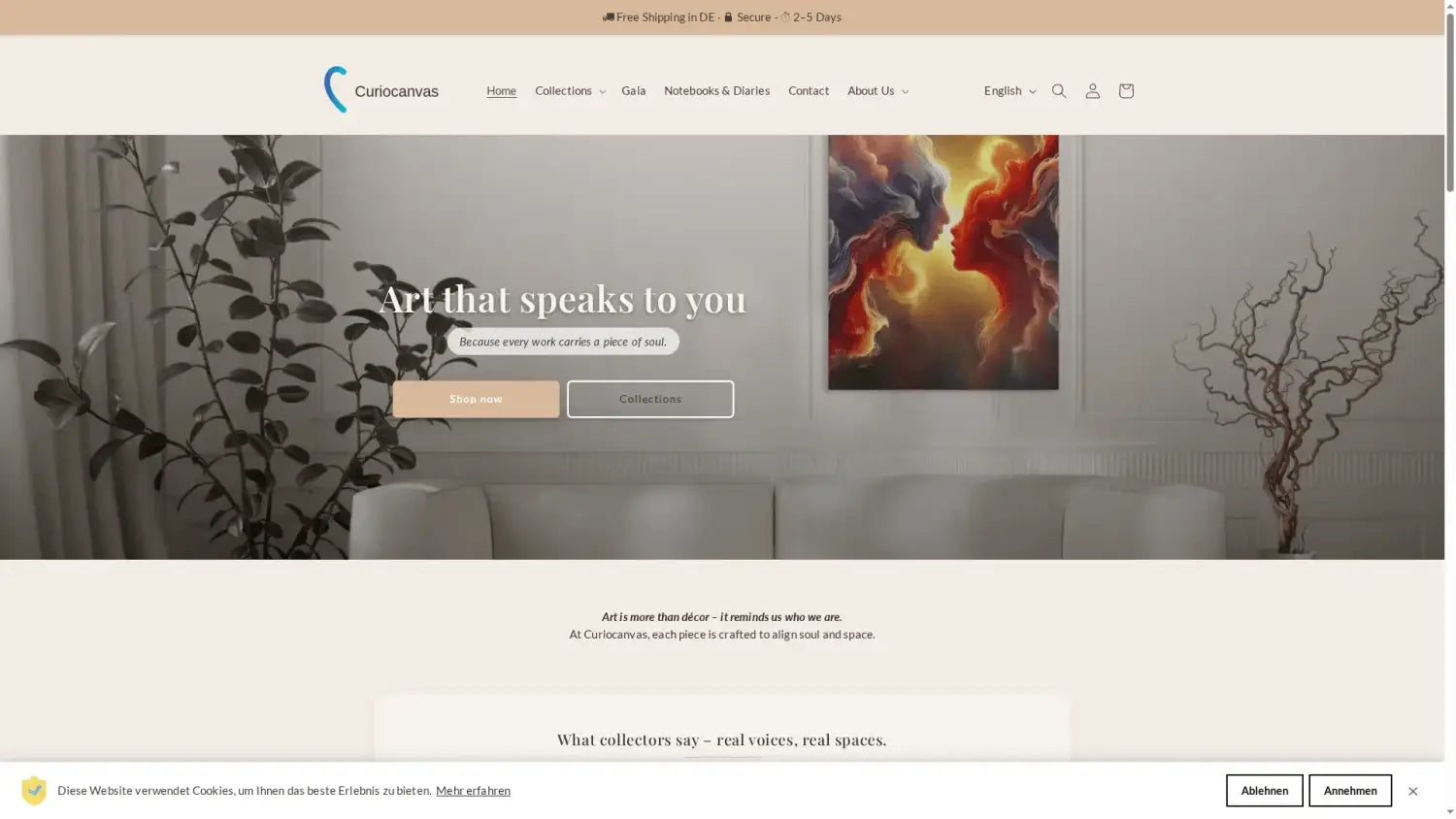
Start your journey to a more conscious and emotionally fulfilling living space with Curiocanvas. Visit curiocanvas.de and discover art that not only adorns walls but enriches your life. Transform your rooms into poetic oases and experience art that speaks to you.
Frequently Asked Questions
How can I use art as a reflection of my personality?
Use artworks that emotionally resonate with you to gain deeper insights into your personality. Observe your reactions and keep an art journal to record your thoughts.
What role do colors play in the emotional perception of a room?
Colors directly influence our mood and well-being. Experiment with different color combinations within two weeks to observe the emotional effects in your room.
How do I choose the right mythological motifs for my room?
When selecting mythological motifs, be sure to choose figures that have personal significance for you. Research the symbolic power of these figures and allow yourself to be inspired by their energies.
What are the advantages of a minimalist art arrangement?
A minimalist arrangement creates clarity and tranquility in the room by focusing attention on essential artworks. Reduce the number of artworks to a maximum of five and choose pieces with clean lines.
How do I integrate symbolic art into my everyday life?
To integrate symbolic art into your daily life, place inspiring artworks in prominent locations and choose motifs that reflect your values. Rotate the artworks once a month to gain new perspectives.
What tips are there for the correct placement of artworks?
The placement of artwork should create energetic harmony. Consider how the placement affects the mood of the room and use balanced colors to generate a positive vibration.
Recommendation
- Art and interior design: Everything you need to know – Curiocanvas
- Why great works of art touch our inner selves – Curiocanvas
- Consciously experiencing art: A guide to poetically designing spaces – Curiocanvas
- What is Art History? Complete Guide 2025 – Curiocanvas
- Asztali Decoráció Trendjei: Stílusos ötletek Anyáknak
- Using Coworking Spaces for Efficient Teamwork | ProOffice Business Center Blog