


How to choose wall art: Emotionally and aesthetically appropriate
Every decision regarding new wall art begins with a connection to your own emotional world. Those who live in a large city like Berlin or Munich and appreciate minimalist spaces know that true art is more than mere decoration. Artwork conveys emotions and can reveal spiritual dimensions , truly reflecting your home. In this guide, you'll find practical inspiration for selecting pieces that resonate with you and enhance your personal atmosphere.
Table of contents
- Step 1: Determine your emotional and spiritual vision
- Step 2: Determine the spatial effect and color harmony
- Step 3: Choose symbolic and minimalist artworks
- Step 4: Check quality and presentation style
- Step 5: Check the impact and personal response
Quick summary
| Important point | Explanation |
|---|---|
| 1. Understanding emotional and spiritual vision | Recognize which feelings and meanings are important to you in order to choose appropriate art. |
| 2. Consider spatial effect and colors | Pay attention to how colors and shapes work in the room and choose art that harmonizes. |
| 3. Choose symbolic and minimalist works | Prefer artworks that are more than just beautiful and have a deeper personal meaning. |
| 4. Check quality and presentation | Pay attention to materials and framing to ensure the longevity and aesthetic impact of your artwork. |
| 5. Check your personal response | Let your intuition decide whether the artwork speaks to you emotionally and has a long-term connection. |
Step 1: Determine your emotional and spiritual vision
Before you dive into the abundance of images, colors, and shapes, you need a clear inner compass. Your emotional and spiritual vision isn't something you bring with you, but something you discover within yourself. This step is about figuring out which feelings and meanings are important to you in your home, so that the wall art you choose not only looks beautiful but also truly feels right.
Start by taking some time to listen to your inner self. Sit down, perhaps with a cup of tea, and ask yourself these questions: What feelings do I want to experience in my home every day? Are you looking for peace and quiet, energy and strength, hope, or transformation? Artwork conveys emotions and acts as a key medium for making these inner states visible and present in your space. It's not about choosing something that simply looks good, but something that speaks to your inner world. For millennials who lead a minimalist lifestyle, this often means that less is more. A single piece that resonates deeply with you emotionally can achieve more than ten superficial pieces.
The spiritual component is equally important. Many of us seek out artworks that carry symbolic meaning, reflecting our personal development or connecting us to something greater. This might be an abstract form representing inner movement, a motif from mythology mirroring your own life journey, or simply a color combination that puts you in a meditative state. Mindfulness plays a key role here. By using mindfulness-based practices like symbolic art appreciation , you can more easily recognize which works truly resonate with your inner life. This isn't emotional guesswork, but a conscious process of self-discovery.
Write down whatever comes to mind. What are the themes that consistently fascinate you? Which colors make you feel refreshed? Which symbols or shapes draw you in like a magnet? It doesn't have to be perfect or logical. The answers you find are your personal key. For example, if you notice that images of growth and transformation attract you, then you seek out artworks that possess this quality. If silence and emptiness draw you in, then minimalist, subtle works are your path. Your vision is a living compass, guiding you to the pieces that feel right in your space and in your heart.
Pro tip: Create a visual pinboard or collection of images that appeal to you over a two-week period, without consciously thinking about style or trends. The patterns you recognize will often reveal more about your true emotional vision than any rational analysis could.
Step 2: Determine the spatial effect and color harmony
Now that you know what emotionally draws you in, it's about translating that vision into the physical reality of your space. A work of art doesn't exist in a vacuum. It interacts with the walls, the light, the other objects, and most importantly, with your feelings in the room. In this step, you'll learn how to choose colors and shapes that not only resonate with your inner vision but also transform your space in subtle yet powerful ways.
Start by truly seeing your space. Go into your room, or the area where you plan to hang the wall art, and observe the light at different times of day. How does the sun fall? What colors are already present in your furniture, your flooring, your accessories? Colors aren't just beautiful; they transform how we feel in a room. Warm tones like rust red or golden ochre create a sense of warmth and comfort, while cool colors like blue or gray-green radiate calm and clarity. The choice between vertical, horizontal, and square formats also significantly impacts how you perceive your space. A vertical piece draws the eye upward and makes a room appear taller, while a horizontal format creates a sense of width and tranquility. For a minimalist lifestyle, this often means that one large, thoughtfully chosen piece achieves more than several smaller ones.
Color harmony doesn't happen by chance, but through conscious choices. If your room is already dominated by neutral tones, you can choose a piece of art that adds a bold splash of color and brings the space to life. Conversely, if your room is already saturated with color, a piece in understated, elegant tones like cream, light gray, or soft green can bring calm and act as a visual anchor. Remember that the colors in a piece of art should "speak" to the existing elements, not clash with them. A deep blue in a piece of art can resonate with blue accents in your room and create coherence. A warm beige can pick up on and enhance the warmth from wooden furniture.
Here is an overview of typical effects of colors and shapes in living spaces:
| Color/Shape | Effect in the room | Recommended for |
|---|---|---|
| Rust red/gold ochre | Warmth, security | Living room, dining area |
| Grey-green/blue | Peace, clarity | bedroom, study |
| Portrait format | It elongates space, makes it appear taller | Small rooms, hallways |
| Landscape format | It has a calming effect and visually expands the visual horizon. | Living spaces, large walls |
| Square | Neutral, harmonious | Any room size, groupings |
Imagine the wall art not just hanging on the wall, but permeating the entire room. It sets the emotional tone. It guides the eye. It creates an atmosphere. For millennials who live consciously and question every object in their home, this is crucial. The artwork needs to feel like it belongs there, like it completes the space, not overwhelms it. Trust your instincts. If a piece feels right, if it creates the spatial effect you envisioned, then you've made the right choice.
Pro tip: Photograph your room from different angles and project or hold artwork in digital form into the images to see how it actually feels in your space before you buy it.
Step 3: Choose symbolic and minimalist artworks
This is where it gets personal. You've found your emotional vision and understand how colors and shapes work in your space. Now it's about choosing artworks that don't just look good, but that speak to something deeper within you. Symbolic and minimalist artworks are often the perfect combination for conscious millennials: they say a lot with little and invite interpretation.

Symbolic art functions differently than purely decorative works. It communicates on a level that transcends the visual. A single tree can signify growth, a labyrinth can represent an inner search, abstract forms can express emotions that words cannot reach. Artists use symbols to depict emotional and spiritual experiences and invite you to look deeper. This is not by chance. When you look at a symbolic work of art, you recognize yourself in it. You see your own questions, your hopes, your journeys. This is the opposite of superficial decoration. It is personal. It is meaningful.
Now combine that with minimalism. Minimalism isn't just an aesthetic style; it's a philosophy that rejects excess and seeks clarity. A minimalist artwork could be a single black line on a white background, a simplified abstract form, or a work using three colors to express an entire emotion. These pieces create space to breathe. They don't force you to process everything at once. Instead, they invite you to slowly look, feel, and understand. For your home, this means your wall art doesn't compete, but complements. It becomes a part of your space, not a distraction from it.
When choosing a piece of art, you no longer just ask yourself, "Do I like this?" but rather, "What does this tell me?" and "Do I need this complexity, or is this simplicity enough?" A minimalist, symbolic work could surprise you anew each day as you discover new meanings. A work of art that reflects your emotional vision and harmonizes with your minimalist lifestyle is no accident. It's a choice that demonstrates you understand who you are and how you want to live. Trust that the right piece will draw you in. It will feel like a dialogue between you and the artwork, not just a one-sided decoration.
Pro tip: Write down what moves you in a symbolic work of art, instead of just describing the visual details. This emotional response will be your most reliable compass when making your selection.
Step 4: Check quality and presentation style
You've found a work of art that resonates with you. It aligns with your emotional vision, your colors, your space. Before you buy it, you need one final, crucial check. Quality and presentation aren't superficial. They determine whether your artwork will still be as vibrant in five years as it is today, or whether it will have faded, become damaged, or simply not look right.
Start with the quality of the materials. A piece of art made from high-quality materials is an investment in your future. If you opt for prints, pay attention to the paper or canvas. Is it thick and sturdy, or does it feel thin and cheap? High-quality prints use inks that won't fade and materials that will last for decades. A cheap print might look beautiful today, but in six months of exposure to sunlight, the colors will lose their vibrancy. This is frustrating if you've chosen a piece that holds special meaning for you. Durability isn't just practical; it's also emotional. You want your artwork to age with you, to become a constant in your space.
Now, let's talk about the presentation. High-quality materials and appropriate framing are crucial for the longevity and aesthetic impact of a work of art. Do you want a frame, a canvas, or a simple print behind glass? A simple white or black frame can harmoniously frame a minimalist piece. A stretched canvas adds depth and a modern energy to the work. A print under glass protects the artwork and emphasizes its presence. But it's not just about what looks good. It's about what works with your space and your habits. If your home is full of natural light, glass could create distracting reflections. If you have pets or small children, glass offers added protection. A canvas allows the artwork to become part of the wall surface without a visual barrier.
Pay attention to size, too. A piece of art that looked stunning in a gallery might look lost on your wall if it's too small. Conversely, a huge piece can overwhelm an intimate space. Think about the relationship between the artwork and the wall, and between the artwork and the furniture. The best rule of thumb is that your artwork should occupy about two-thirds of the wall's width if it's hung centrally, or it should connect with other elements in the room. Visualize how it will look before you buy. Take a photo or place a piece of cardboard the size of the artwork on your wall. It takes five minutes and can prevent regrets costing hundreds of euros.
Finally, examine the production. Where does the artwork come from? Is it produced by a trustworthy source? A good artwork should be transparent about its origin, materials, and manufacturing process. This gives you the assurance that you're truly receiving what you expect. A high-quality artwork isn't a cheap impulse buy. It's a thoughtful decision, a piece that will resonate with you for years to come.
To make a better decision, consider these quality aspects when buying art:
| criterion | Why it's important | What to look out for |
|---|---|---|
| Material quality | Durability & Colorfastness | Thick paper, lightfast ink |
| framing | Protection and effect | Suitable frame, no warping |
| Size | Spatial harmony | Choose in relation to the wall |
| Origin | Transparency & Sustainability | Proof of origin, fair production |
Pro tip: Compare the product descriptions of at least two similar works before making your decision to ensure that the quality and presentation actually meet your expectations and space requirements.
Step 5: Check the impact and personal response
You're almost at the end of your selection process. You've clarified your emotional vision, considered its impact on the space, explored symbolic and minimalist works, and assessed the quality. Now comes the most crucial step, the one that ties everything else together: You need to verify whether the artwork truly resonates with you. This isn't rational. It's personal.
When you look at a work of art that interests you, pause. Not for a second, but for several minutes. How does it feel to look at this work? Is there a moment when something awakens within you? It could be joy, sadness, wonder, or even discomfort. All these reactions are meaningful. If you feel uneasy, it could be a sign that the work isn't for you, no matter how beautiful it is. On the other hand, if you feel drawn to it, if your gaze keeps returning to certain details, if you begin to see stories in it that you hadn't seen before, then the artwork is speaking to you. Your personal emotional response is closely linked to your own emotional history and allows you to experience the symbolism and impact authentically.
This is the moment when you trust your intuition. You know yourself. You know which images and symbols resonate with you, which colors energize you, and which soothe you. You know whether you need something powerful and demanding to challenge you, or something gentle and supportive to ground you. Stand before your potential artwork and don't ask yourself, "Is it beautiful?" or "Does it match my decor?" Instead, ask yourself the questions that matter. Will I still look at this piece with the same attention in a month? Will it support me through difficult times? Will it remind me of something important? Will I still feel connected to this piece in a year?
The impact of a work of art changes depending on who you are and where you are in life. A piece of art that supports you on your journey of self-discovery today will continue to accompany you as you evolve. This is what makes the choice so meaningful. You're not just choosing something for your wall; you're choosing a silent companion for your life. Trust this personal resonance. It's your own inner knowing that tells you whether this artwork truly resonates with you. There is no "wrong" here, only your truth. And your truth is the only one that matters.
Pro tip: Sleep on your decision before buying and check the next day if the emotional connection you felt is still there. A genuine connection remains, superficial attraction fades.
Choose wall art with heart and mind
Choosing the perfect wall art is an emotional journey, not just about aesthetic harmony, but also about finding a personal expression that fills your home with meaning. Our guide shows you how to find a piece of art that truly speaks to you, from your inner vision to its spatial impact and symbolic depth. This is precisely where Wall Art Gallery Flames Kisses Time and Compass – Curiocanvas comes in: exclusive, symbolic, and minimalist artworks that touch the heart and connect your home with profound meaning.
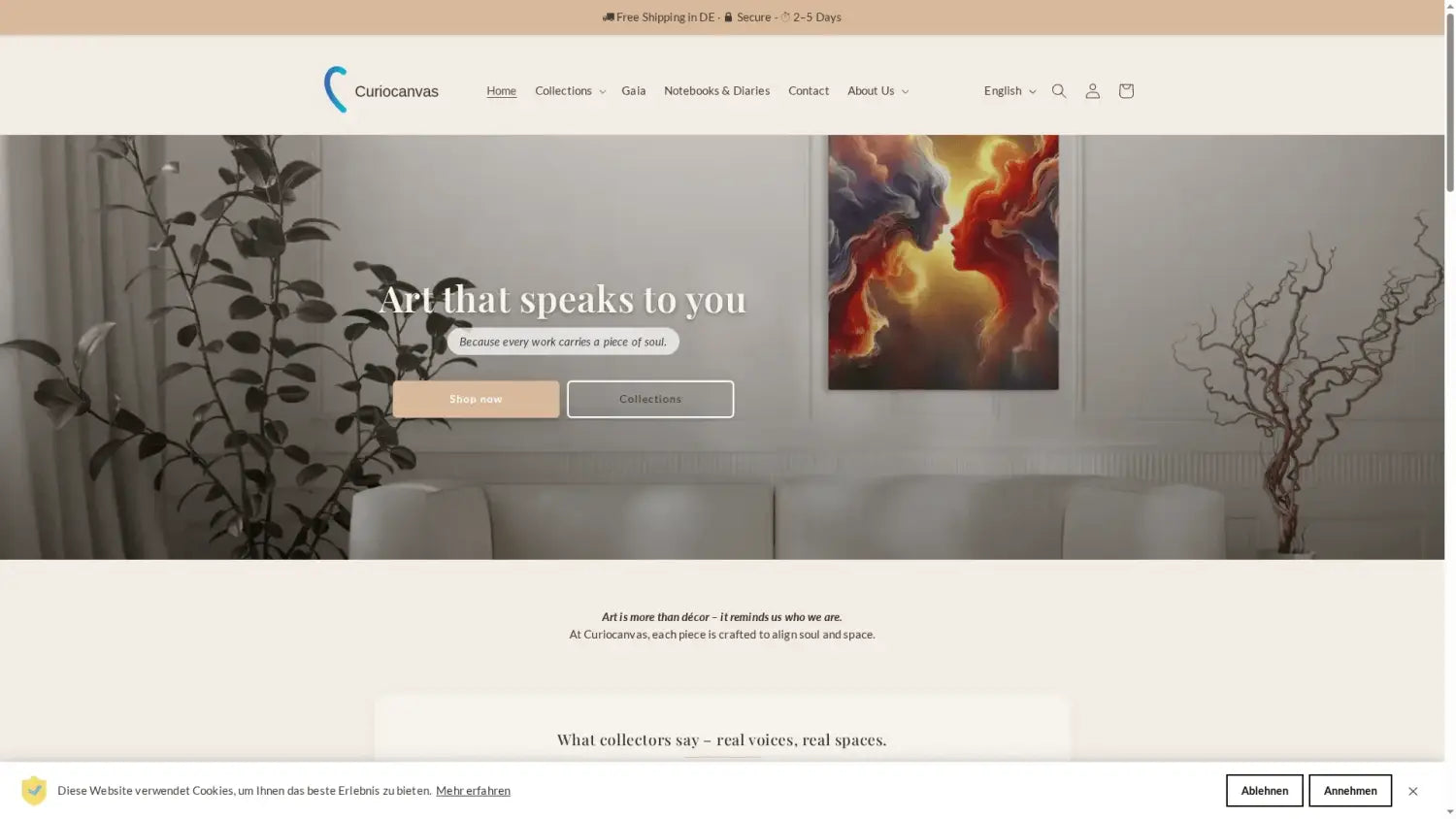
Discover wall art at Curiocanvas that is so much more than just decoration. Our collection blends poetry and spiritual symbolism into high-quality, lasting artworks that will inspire you every day. Immerse yourself in artwork as a mirror of your soul. Discover the Curiocanvas homepage and begin your journey to wall art that enriches your life. Don't wait for the perfect moment; create it now with art that reflects your heart.
Frequently Asked Questions
How do I find my emotional vision for wall art?
To find your emotional vision, take time for self-reflection and ask yourself what feelings you want to experience in your home. Sit down with a cup of tea and write down the themes, colors, and symbols that attract you.
What colors should I choose for my wall art?
Choose colors that harmonize with the existing elements in your room. Keep in mind that warm tones like rust red or golden ochre create warmth, while cool colors like blue or gray-green radiate calm.
What is important when selecting symbolic artworks?
When choosing symbolic artwork, make sure it has a deeper meaning for you and expresses emotions that resonate with you. Consider which symbols reflect your personal development and what message you want to convey in your life.
How do I check the quality of a work of art before buying it?
Pay attention to the material quality; this means the artwork should be made from sturdy materials. Also check the framing and workmanship to ensure it's durable and fits well in your space.
How can I check the resonance of a work of art with myself?
To assess the resonance of a work of art, look at it for several minutes and pay attention to the emotions it evokes in you. If you feel drawn to it and sense a connection, that's a good sign that it resonates with you.
What does it mean to choose a minimalist approach to wall art?
A minimalist approach means selecting artworks that are simple yet meaningful, so they don't clutter or distract. Opt for a few, but impactful pieces that support and complement your space, rather than overwhelming it.