


Symbolic artworks explained: meaning and effect
A surprisingly large number of people underestimate the power of symbolic art. These works offer far more than just beautiful images, as they express complex thoughts and feelings through symbols. It is particularly fascinating that colors in art can measurably evoke strong emotions such as gratitude or anger . Those who understand how symbols work discover new levels of meaning in artworks and gain access to deeper layers of human experience.
Table of contents
- What are symbolic works of art? Definition and origin
- Important types and symbolic motifs
- Key features and emotional impact
- Symbolic art today: Applications in interior design
- Avoid common mistakes and misunderstandings
Key findings
| Point | Details |
|---|---|
| Symbolic artworks as a form of expression | They convey deeper meanings and human experiences through visual metaphors and symbols. |
| The effect of colors and emotions | Colors in symbolic artworks evoke strong emotional reactions and enable reflective experiences. |
| Application in interiors | Symbolic art is used deliberately to create an emotional atmosphere in spaces and to emphasize personal meanings. |
| Avoiding misunderstandings | Symbolic works of art are often reduced to mere decoration; a deeper examination is essential for understanding their meaning. |
What are symbolic works of art? Definition and origin
Symbolic artworks are more than mere visual representations – they are complex forms of expression that convey deeper meanings and human experiences. Symbolic art arises from the need to communicate abstract concepts, emotions, and philosophical ideas through visual metaphors and signs.
According to de.wikipedia.org, Symbolism in the visual arts developed in the late 19th century as a direct response to the prevailing Realism and Naturalism. Artists like Max Klinger recognized that true artistic expression lies not in the exact reproduction of reality, but in the ability to visualize invisible worlds and inner states.
The philosopher Ernst Cassirer viewed art as a symbolic form that allows for the interpretation and expansion of reality through creative expression (de.wikipedia.org ). Symbolic artworks thus function as bridges between the visible and the invisible world. They invite viewers to move beyond superficial perception and explore deeper levels of meaning.
The main characteristics of symbolic artworks include:
- Use of metaphors and allegories
- Emphasis on emotional and spiritual states
- Transformation of real objects into meaningful symbols
- Invitation to individual interpretation
Ultimately, symbolic artworks are not merely objects, but windows into complex inner landscapes of human experience and imagination. They challenge us to look beyond the visible and to decipher the poetic language of symbols.
Important types and symbolic motifs
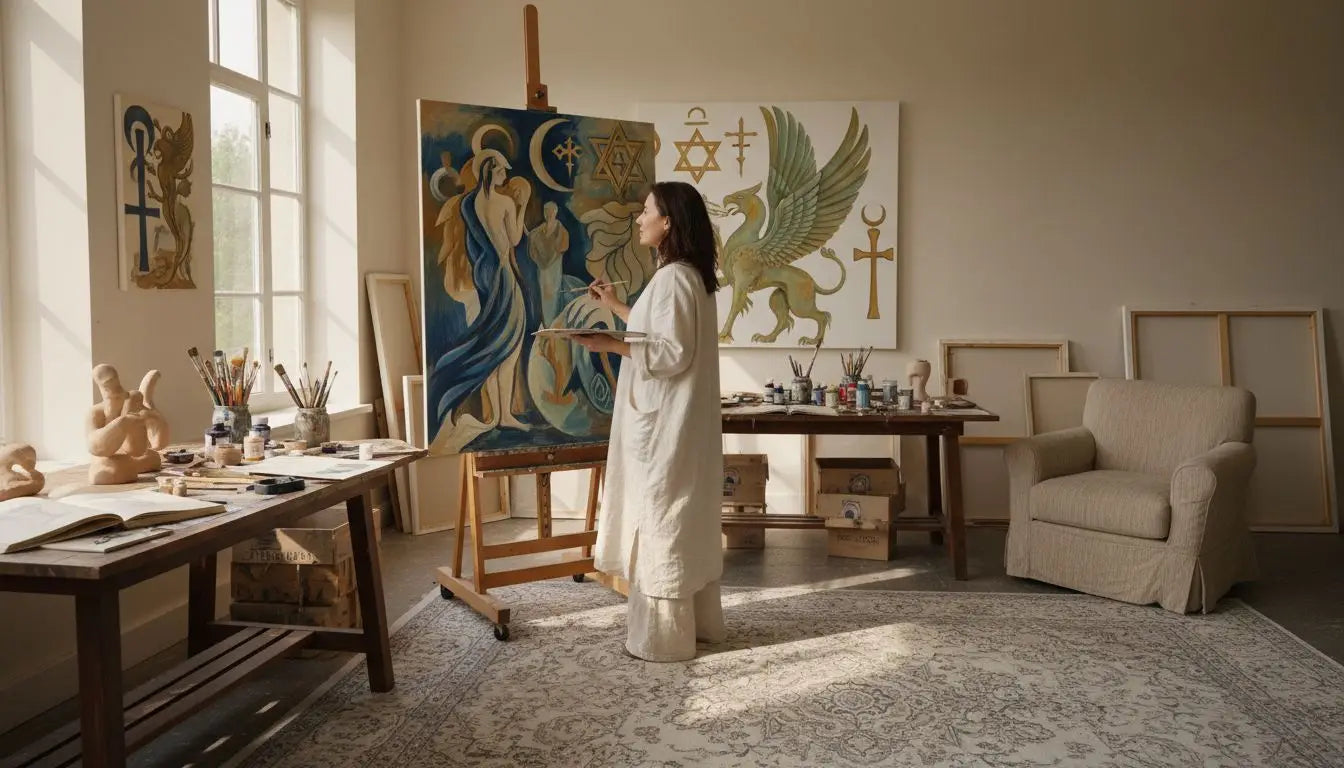
Symbolic artworks encompass a rich and diverse range of motifs and forms of expression deeply rooted in the human psyche and cultural imagination. These artworks transform everyday elements into meaningful symbols that transcend their original visual appearance.
Wikipedia (de.wikipedia.org) shows that Symbolist artists frequently used motifs such as dreams, myths, and the unconscious to depict complex ideas and emotions. These motifs served to transcend visible reality and convey deeper truths.
According to de.wikipedia.org, Nelson Goodman, in 'Languages of Art', examined various symbolic systems and how different art forms communicate through symbols. This analysis reveals that symbolic motifs are not merely decorative, but function as complex communication systems.
Here are some key types of symbolic motifs:
- Nature motifs : Trees as symbols of life and growth
- Mythological motifs : Gods and heroes as embodiments of human archetypes
- Religious motifs : Sacred symbols and spiritual transformations
- Emotional motifs : Abstract representations of feelings and inner states.
These motifs invite the viewer to look beyond the visible and discover personal meanings. They are like poetic languages that tell stories without using words.
 Seven inspiring works of art as meaningful gift ideas offer further insight into the profound meaning of symbolic artworks.
Key features and emotional impact
Symbolic artworks possess a profound ability to touch and transform human emotions. They are not passive objects, but active instruments of emotional communication that make the complex inner landscapes of our emotional world visible.
A fascinating study from arxiv.org explored the profound associations between colors and emotions in art. The research revealed that certain colors evoke surprisingly strong emotional responses—for example, green can evoke feelings of gratitude, while brown can be associated with anger.
According to de.wikipedia.org, the philosopher Ernst Cassirer emphasized that works of art objectify emotions through their form. They allow the viewer to experience feelings in a reflective, detached, and yet intense way. Aesthetic experience is thus understood not as passive contemplation, but as an active, meaning-making process.
Key features of the emotional impact of symbolic artworks include:
- Transformative power : the ability to visualize inner states
- Emotional resonance : Direct emotional appeal beyond rational levels
- Universal language : Overcoming linguistic and cultural boundaries
- Therapeutic dimension : Opportunity for self-reflection and processing
Emotional Art in the Home: The Complete Guide offers an in-depth look at how symbolic artworks can expand and enrich our emotional landscape. They are more than decoration—they are mirrors of our soul.
Symbolic art today: Applications in interior design
Symbolic artworks have long since found their way from museums and galleries into our personal living spaces. They are more than mere decoration – they are emotional maps that fill our living space with meaning and depth.
According to de.wikipedia.org, Goodman's analysis of symbolic systems shows how art forms in interior design communicate through symbols and create atmospheres. A symbolic artwork can not only visually alter a room, but also transform its emotional vibration and energetic quality.
Modern interior design understands symbolic art as a strategic design element. Artworks are deliberately placed to create specific moods, tell personal narratives, and imbue spaces with individual meaning. They function as silent storytellers of our dreams, values, and inner landscapes.
Practical applications of symbolic art in interior design include:
- Living areas : Creating emotional anchor points
- Workspaces : Inspiration and mental stimulation
- Bedroom : Promoting rest and reflection
- Common areas : Communication without words
Beautifying living rooms with art: Her unique style offers practical insights into how symbolic artworks can not only decorate rooms, but also enliven and transform them.
Avoid common mistakes and misunderstandings
Symbolic artworks are often misunderstood regarding their deeper meaning and impact. Many people reduce them to mere decoration or superficial aesthetic objects, thus obscuring their true power.
According to de.wikipedia.org, Martin Heidegger warned against viewing works of art merely as physical objects with symbolic meaning. He emphasized that works of art are independent entities that reveal a deeper reality—they are not just objects, but windows to more complex levels of understanding.
de.wikipedia.org highlights Cassirer's perspective that art is not merely an expression of subjective emotions, but creates objective meanings through form. A common mistake is to see artworks only as personal expressions without recognizing their deeper symbolic dimension.
Here are some typical misunderstandings to avoid:
- Reducing artworks to mere decoration : misunderstanding artworks as mere wall decorations.
- Superficial interpretation : Evaluating symbols based solely on first impressions.
- Emotional distance : viewing artworks only rationally.
- Cultural narrowing : Interpreting symbolic meanings only from one's own perspective.
To truly understand symbolic works of art, one needs openness, empathy, and a willingness to look beyond the visible.
Discover the magic of symbolic artworks for your home
Symbolic artworks challenge us to look beyond the visible and discover deeper meanings. If you are looking for a way to fill your spaces with emotional depth and spiritual resonance, then Curiocanvas' works offer precisely the combination of aesthetic beauty and symbolic power you need. Here, metaphors and emotional messages meet minimalist-luxurious design, lending your home a unique atmosphere.
Bring your walls to life with a selection from our Wall Art Gallery: Flames, Kisses, Time and Compass , and create emotional focal points in your living spaces. Harness the power of symbolic art as a reflection of your inner world and as inspiration for everyday life. Visit curiocanvas.de now and transform your surroundings with artworks that not only decorate but also deeply touch the heart.
Frequently Asked Questions
What are symbolic works of art?
Symbolic artworks are complex forms of expression that convey deeper meanings and human experiences through visual metaphors and signs.
What motifs are frequently used in symbolic art?
Frequently used motifs in symbolic art include nature motifs, mythological motifs, religious symbols, and emotional representations that go far beyond superficial perception.
How do symbolic works of art affect our emotions?
Symbolic works of art possess the ability to touch and transform emotions by visualizing inner states and generating emotional resonance.
What role does symbolic art play in interior design?
Symbolic artworks enrich our living spaces by creating emotional anchor points and changing the atmosphere of a room, thereby telling individual meanings and personal narratives.