


Using art for self-reflection: Your path to greater self-knowledge
A quiet moment at home can be the starting point for a profound, creative journey. For many people in Germany, art is more than just decoration; it offers the opportunity for self-reflection and emotional healing. Those who consciously prepare a space and use art as a mirror to their feelings discover a new understanding of their own identity. This article shows how creating a calm and protected space can help you unleash your creativity and transform living spaces in a meaningful way.
Table of contents
- Step 1: Consciously prepare your space and mind
- Step 2: Choose works that reflect your emotions
- Step 3: Actively reflect on your feelings while viewing.
- Step 4: Capture your thoughts creatively
- Step 5: Mindfully integrate these insights into your everyday life
Quick summary
| Important point | Explanation |
|---|---|
| 1. Consciously prepare the space and your mind | Create a quiet space and meditate beforehand to be creative. |
| 2. Reflecting emotions through art | Look for artworks that reflect your inner feelings and emotions. |
| 3. Active reflection of feelings | Look at works of art mindfully and explore your emotions without judgment. |
| 4. Use creative documentation | Capture your thoughts and feelings in a creative way to deepen them. |
| 5. Integrate insights into everyday life | Mindfully integrate the insights gained during your reflection into your everyday life. |
Step 1: Consciously prepare your space and mind
Preparing your creative space is crucial for a deep process of self-reflection. It's about creating an environment that supports and encourages your inner journey.
Start by creating a calm and protected space . Choose a place where you feel safe and undisturbed. Ideally, it should be a room that exudes a gentle, inviting atmosphere —a place where your mind can find peace. Quiet spaces can significantly support a creative process .
To prepare your room, I recommend the following steps:
- Reduce visual distractions
- Ensure pleasant, soft light
- Provide a comfortable seating option.
- Place materials within easy reach.
- Create an atmosphere of warmth and security.
Mental preparation is just as important as physical preparation. Take time for a short meditation or breathing exercise to calm and focus your mind. Let go of the pressure to be perfect and open yourself to your intuitive creative power.
A deliberately prepared environment can significantly deepen the creative process of self-reflection.
Pro tip: Prepare some tea or a warm blanket to further support and pamper yourself during the creative process.
Step 2: Choose works that reflect your emotions
In this step, you will learn to find artworks that function like a mirror to your inner emotional world. It's about discovering art that touches and reflects your deepest emotional states.
Artworks can serve as emotional sounding boards , bringing our hidden feelings to the surface. When choosing one, pay attention to the following criteria:
- Which colors appeal to your emotions?
- Which forms and compositions move you?
- What emotions does the artwork evoke in you?
- Do you feel an immediate inner connection?
- Do you recognize yourself in the work?
The choice is very personal. Trust your intuitive feeling . Don't be guided by art reviews or the opinions of others, but by your own emotional impulse.
Art that touches your soul can be the key to self-discovery.
Pro tip: Take your time for quiet contemplation and listen to your inner feeling when looking at a work of art.
Step 3: Actively reflect on your feelings while viewing.
In this step, you will learn how to not only passively observe works of art, but actively use them as a tool for self-reflection. It's about developing a deep emotional connection and consciously perceiving your inner reactions.
Art can evoke emotions and allows for their reflection and processing. Begin by mindfully observing the artwork and note your initial impulses:
- What feelings arise within you?
- Where do you feel reactions in your body?
- What memories or associations arise?
- Are there any surprises in your emotional response?
- Can you name and describe the feelings?
Remain fully present while viewing the artwork . Don't judge your emotions, simply observe them. Allow the artwork to act like a mirror, revealing hidden feelings.
Self-reflection means exploring one's own emotions without judgment.
Pro tip: Keep a reflection journal in which you record your feelings and thoughts after viewing the art.
Step 4: Capture your thoughts creatively
This step shows you how to deepen your art appreciation and self-reflection through creative documentation. You will learn to capture your inner impulses and emotions in a way that goes beyond traditional writing.
Journaling can be used as a creative method of self-reflection . Experiment with different creative documentation techniques:
- Sketch your feelings next to the artwork
- Color areas of your journal that represent specific emotions.
- Use collages or collage techniques
- Paint abstract shapes that symbolize your feelings.
- Combine text with visual elements
Trust your creative impulse . It's not about artistic perfection, but about honest expression. Let your intuition guide you and don't shy away from unconventional forms of expression.
Creative capturing makes it possible to visualize complex inner states.
Pro tip: Save your creative documentation and look at it later - you will discover surprising developments.

The following table provides an overview of how different creative methods can contribute to self-reflection:
| method | The goal of the method | Suitable application |
|---|---|---|
| meditation | Mental focus and calming | Start of the process |
| Creative Journaling | Express emotions visually | After viewing the art |
| Keep a diary | Document findings sustainably | Integration into everyday life |
| Design of collages and sketches | Making deep emotions visible | During reflection |
Step 5: Mindfully integrate these insights into your everyday life
This step helps you to consciously and vividly integrate the insights gained during your art appreciation into your everyday life. It's about not just reflecting on your inner experiences, but actively living them.
Mindfulness can be integrated into everyday life as part of personal development . Develop strategies to keep your insights alive:
- Take time each day for a short reflection
- Connect your art knowledge with concrete actions.
- Visualize key findings in visible locations.
- Share your experiences with people you trust.
- Stay open and patient with yourself.
Turn knowledge into action . Every small change counts. You don't have to implement everything at once; you can proceed carefully and mindfully.
The conscious integration of insights promotes personal growth and emotional resilience.
Pro tip: Keep a diary in which you document how your self-perception develops after viewing art.
This table summarizes the effects of viewing art on personality development:
| aspect | Positive effect | Long-term benefits |
|---|---|---|
| Emotional Resonance | Promotes access to inner feelings | Strengthens self-awareness |
| Active self-reflection | Deepens self-awareness | Increases emotional intelligence |
| Creative processing | Creates new forms of expression | Supports emotional coping |
| Mindful Integration | Encourages conscious lifestyle design | Promotes personal development |
Discover your deepest self-knowledge through art
This article shows how art can help you accurately reflect your feelings and gently integrate important inner insights into your life. If you often find yourself lacking the right expression for your emotions or want to take your self-reflection to a new level, you are not alone. The conscious selection of artworks that act like a mirror to your soul is key to your personal growth and emotional clarity.
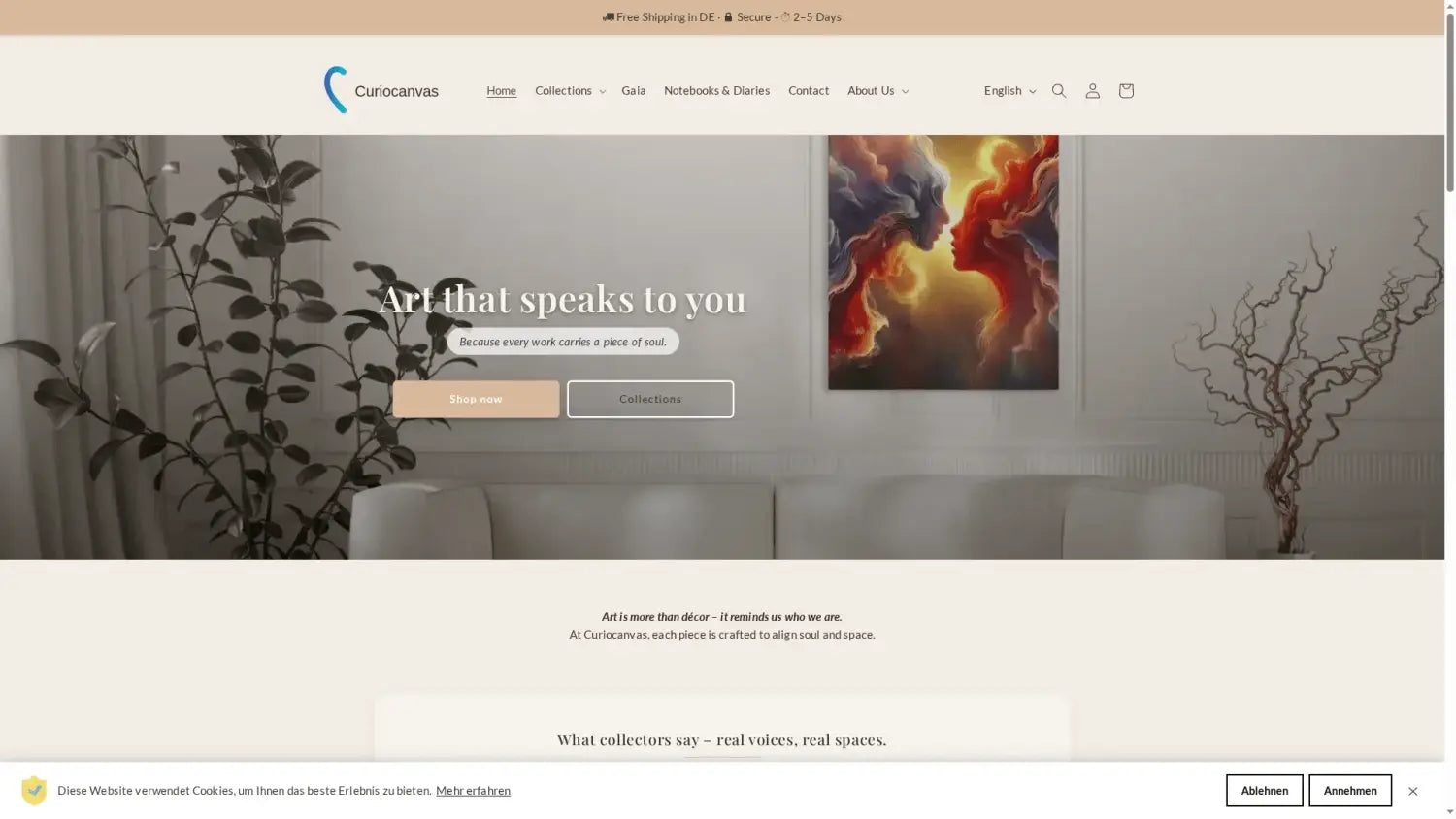
Awaken your home with art that reflects your inner world and fosters greater mindfulness. Discover artwork as a mirror of your soul on the Curiocanvas homepage, where poetic motifs merge with emotional depth. Be inspired by our selection of wall art, such as "Flames Kisses Time and Compass" and "Poetry in Motion as Art on Canvas," and transform your spaces into places of self-reflection. This is your moment to take action and consciously use art to guide your path to greater self-knowledge. Visit us at Curiocanvas.de and find the motif that speaks to your soul!
Frequently Asked Questions
How can I create a quiet space for self-reflection using art?
To create a suitable space for self-reflection, reduce visual distractions and ensure pleasant lighting. Begin by designing your space in a way that invites you to relax and reflect.
Which works of art are best suited to reflecting my emotions?
Choose artworks that resonate with you on an emotional level and reflect your feelings. Pay attention to colors, shapes, and emotions that touch you to create a deeper connection.
How can I actively reflect on my feelings when viewing art?
Use mindfulness to pay attention to your emotional reactions when viewing artworks. Ask yourself questions like: What feelings arise within me? Write down your answers in a reflection journal.
What creative methods can I use to capture my thoughts?
Experiment with creative techniques like journaling, sketching, or collage to visually express your emotions. For example, start with a sketch of your feelings or create a collage from different materials.
How do I integrate my insights from viewing art into my everyday life?
Set aside time each day for reflection and consider how you can actively implement your insights. Visualize your most important experiences in visible places to remind yourself and stay mindful.
Why is self-reflection through art important for my personal development?
Self-reflection through art fosters access to your inner feelings and strengthens your self-awareness. Regularly take time to integrate this practice into your daily life to develop long-term emotional resilience.