


Creating a meaningful gallery wall: Experiencing art with soul
Over 60 percent of people want a gallery wall that reflects their personality, not just a bare decoration. A custom-designed gallery wall transforms any room into a gallery of personal memories and feelings. Whether urban style in Berlin or traditional motifs from Munich, with the right approach you can create a unique work of art that makes your emotions and your life journey visible.
Table of contents
- Step 1: Define your personal visual language
- Step 2: Select inspiring works of art
- Step 3: Combine formats and colors harmoniously
- Step 4: Arrange your gallery wall intentionally
- Step 5: Check the emotional effect in the room
Quick overview
| Important point | Explanation |
|---|---|
| 1. Develop your visual language | Reflect on your emotions and experiences to create an authentic visual identity. |
| 2. Select significant works of art. | Look for artworks that reflect your inner world and create a strong emotional resonance. |
| 3. Combine formats and colors | Pay attention to color palettes and formats to achieve harmony and an emotional connection in your gallery wall. |
| 4. Arrange deliberately | Experiment with the arrangement of your artwork to create dynamic and meaningful narratives. |
| 5. Check the emotional impact | Observe how the images interact with light and space to understand their emotional impact and adjust them if necessary. |
Step 1: Define your personal visual language
Your gallery wall is more than just a collection of pictures; it's a visual diary of your soul. To develop an authentic visual language, you must first delve deep into your inner landscapes. Discovering your artistic identity means not only learning technical skills but also translating your personal experiences and emotions into visual narratives.
Begin with honest self-reflection. What moments have shaped you? What feelings do you want to express? Artists often learn through experimentation how to develop self-portraits that are more than just a representation; they are an interpretation of their inner reality. Try different techniques such as sketching, collage, or digital media to discover which form of expression best conveys your emotions.
A practical tip: Start by gathering inspiration in a visual journal. Paste together photos, sketches, color swatches, and personal notes. This creative process will help you discover and refine your individual visual language. Your gallery wall will then become a living reflection of your inner world—a work of art that lets your soul breathe.
Step 2: Select inspiring works of art
Selecting inspiring artwork is a deeply personal and emotional process. Your gallery wall shouldn't just be decorative; it should tell a story, reflecting a journey of your feelings and experiences. Choosing art based on emotional responses doesn't simply mean collecting beautiful pictures, but finding those that create a deeper connection to your life's moments.
Begin by taking an honest inventory of your inner landscape. Which artworks truly resonate with you? Which motifs make your soul vibrate? Look for images that are not only aesthetically pleasing but also tell a story. These can be abstract compositions that reflect your feelings, as well as figurative works that symbolize a specific moment in your life. The key is to choose artworks that are more than mere decoration; they are windows into your inner world.
A valuable tip: Create a collection of images that resonate with you emotionally. Mentally review your most significant life events and look for visual metaphors that capture these experiences. Your gallery wall will then become a personal art journal, a living archive of your emotions and dreams. Take your time curating; each image should evoke a resonance in your heart.
Step 3: Combine formats and colors harmoniously
The art of a harmonious gallery wall lies in the subtle balance of formats, colors, and emotions. Flexible presentation of artwork allows you to experiment creatively and craft your own personal visual narrative. Think of your wall as a canvas where each piece of art is part of a larger, cohesive work.
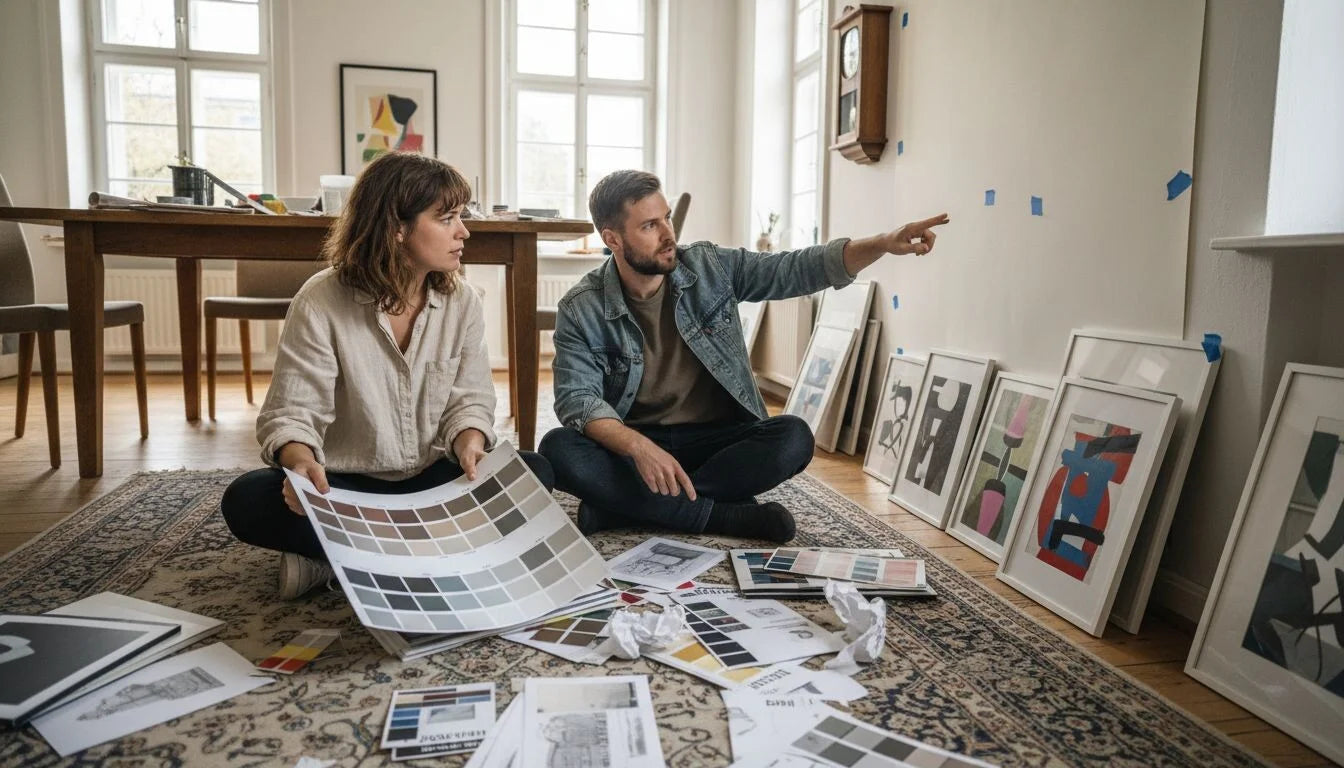
Begin with visual research. Select images with related color palettes but different formats. A large-format abstract painting can contrast beautifully with smaller photographic works. Pay attention to the color temperatures and moods of the images. Warm earth tones can balance cooler blue or gray hues. Sustainability in color selection means not only being environmentally conscious but also creating emotional coherence.
A professional tip: First, arrange your pictures provisionally on the wall using paper templates. Experiment with spacing and orientation. Each artwork should have room to breathe while simultaneously being part of a harmonious ensemble. The perfect gallery wall isn't created through perfection, but through an authentic connection between the artworks and your feelings.
Step 4: Arrange your gallery wall intentionally
Consciously arranging your gallery wall is a meditative journey of self-discovery. Creative arrangement techniques with flexible frames allow you to compose your artwork like a living mosaic of your emotions. Imagine your wall as a dynamic canvas where each picture tells a story and communicates with the others.
Begin with a visual choreography. First, place your artworks on the floor and experiment with different groupings. Pay attention to the rhythm of the images, their spacing, and the resulting tensions. A large image can serve as an emotional anchor point, while smaller works around it develop a narrative. Sustainable interior design means not only choosing environmentally conscious materials but also creating a harmonious flow of energy.
An important tip: Photograph your temporary arrangements. This allows you to gain distance and view the overall composition objectively. Trust your intuitive perception. A meaningful gallery wall isn't created through mathematical precision, but through an authentic emotional connection.
Step 5: Check the emotional effect in the room
The emotional impact of your gallery wall is a subtle dialogue between art, space, and soul. The profound reflection of artistic emotions requires more than a fleeting glance; it demands a mindful awareness of your inner reactions.
Sit in your room at different times of day and observe how the artworks interact with the changing light. Self-portraits as emotional maps can help you understand how art influences our perception. Pay attention to the resonances: Which images attract you? Which ones unease you? Which ones soothe you?
A crucial tip: Trust your first emotional reaction. An authentic gallery wall isn't about perfect design, but rather a vibrant expression of your inner landscape. If a picture no longer speaks to you, don't hesitate to replace it. Your wall should breathe, tell a story, and reflect your soul.
Give your gallery wall soul and depth with Curiocanvas
Creating a meaningful gallery wall calls for art that not only decorates the space but also authentically reflects emotions and tells stories. If you're consciously arranging your artwork and seeking the perfect expression of your inner landscape, Curiocanvas supports you with a selection of poetic and symbolic wall art that creates precisely this connection. Our Wall Art Gallery, Flames Kisses Time and Compass, offers a diverse range of motifs that enrich your personal visual language and evoke a profound emotional response.
Discover how our collection can transform your walls into vibrant works of art that breathe and speak. Start creating your personal gallery wall today with art that's more than just decoration—art with soul. Visit us at Curiocanvas and be inspired by the Celestial Winter Capsule 2025 Light Quiet Connection to find the perfect emotional anchor for your spaces. Design your unique gallery wall now and experience true visual poetry.
Frequently Asked Questions
How do I find my personal visual language for my gallery wall?
To develop your personal visual language, begin with honest self-reflection on your inner experiences and emotions. Write down your thoughts and feelings and experiment with different techniques such as sketching or collage to discover which form of expression best conveys your emotions.
Which works of art are best suited for a meaningful gallery wall?
Choose artworks that resonate with you emotionally and tell a story. Reflect on your most significant life events and seek out images that offer visual metaphors for these experiences to forge a deeper connection.
How can I harmoniously combine formats and colors?
Begin with visual research by selecting images that share related color palettes but have different formats. Experiment with arrangements using paper templates to test spacing and orientations, ensuring each piece of artwork becomes part of a harmonious whole.
What techniques can I use to consciously arrange my gallery wall?
First, arrange your pictures provisionally on the floor to try out different groupings and spacings. Pay attention to the rhythm and the emotional anchor points you create by combining different sizes and styles.
How do I check the emotional impact of my gallery wall in the room?
Sit in the room at different times of day and observe how the artworks interact with the light. Take your time to notice your emotional reactions and decide if you want to replace a picture that no longer reflects your current mood.
What do I do if a picture no longer fits in with my gallery wall?
If a picture no longer speaks to you, don't hesitate to remove or replace it. Your gallery wall should remain a vibrant expression of your inner world, which can change over time.