


7 inspiring examples of poetic art to imitate
You know the longing to connect more deeply with art and expand your repertoire of creative expression. But the question quickly arises: how can language, image, and poetry truly merge in modern art to avoid remaining superficial? Often, concrete approaches for powerfully uniting word, image, and symbol are lacking.
Here you'll find clear inspiration and practical guidance that shows you how to rediscover poetic art and apply it in practice. From minimalist, condensed haiku to symbolically rich collages, you'll get fresh ideas for your own creative work.
This list reveals diverse ways to combine text, image, and motif into meaningful works of art. Be surprised by the simple methods and creative techniques hidden behind each item.
Table of contents
- What makes poetic art: The connection between word and image
- Haiku artworks: Minimalism with profound meaning
- Mythological symbols as a source of poetic inspiration
- Utilizing emotional color harmonies in wall design
- Quote art: Meaningful words as a visual focal point
- Symbolic motifs in a modern, minimalist aesthetic.
- Poetic collages: a combination of text fragments and images
Brief summary
| Key finding | Explanation |
|---|---|
| 1. Combination of word and image | The interaction between language and visual design opens up new perspectives on meaning. |
| 2. Haiku as a contemporary art form | Minimalist forms require precise observation and convey complex emotions in just a few words. |
| 3. Use mythological symbols | Ancient narratives offer inspiring archetypes that resonate with universal human experiences. |
| 4. Recognizing emotional color harmonies | Colors influence our atmosphere and can be used to create specific moods. |
| 5. Create poetic collages | The combination of text and image allows for a new narrative depth and subjective interpretation. |
1. What constitutes poetic art: The connection between word and image
Poetic art thrives on a magical dialogue between language and visual representation. It transforms words into images and images into words, creating a multi-layered level of communication that goes deeper than mere decoration.
The connection between word and image is more than a chance encounter of two forms of expression. It is a complex interplay in which poetry and visual design complement and expand each other.
Three essential aspects characterize this artistic connection:
- Mutual interpretation : Text expands on the image's message and vice versa.
- Emotional intensification : Words and images together create a deeper level of meaning.
- Dynamic interaction : Both media transform each other reciprocally.
Artists use various techniques for this connection:
- Calligraphic embedding of texts in works of art
- Visual poetry with graphically designed letters
- Collages made from text fragments and visual elements
The combination of word and image creates a space beyond mere representation – a space of meaning and emotion.
Pro tip: Experiment with combining words and images in your creative process and let yourself be guided by mutual inspiration.
2. Haiku artworks: Minimalism with profound meaning
Haiku is more than just a poetic form – it's an art form that blends poetry and visual reduction into a unique expression. This Japanese art form celebrates the beauty of the ephemeral through precise observations of nature and minimalist design.
The structure of a haiku traditionally follows a strict 5-7-5 syllable rhythm. However, it's not about mathematical perfection, but about capturing the essence of a moment.
Haiku artworks are characterized by:
- Focus on the moment : A single instant is condensed.
- Reference to nature : Seasons and natural phenomena are often themes.
- Emotional depth : Despite its brevity, complex feelings are conveyed.
Practical steps for creating a haiku artwork:
- Choose a fleeting moment
- Reduce the description to the essentials.
- Combine text with minimalist visual design
A haiku is like a breath of poetry - short but meaningful.
Pro tip: Experiment with calligraphy and visual design to add an extra artistic dimension to your haiku.
3. Mythological symbols as a source of poetic inspiration
Mythological symbols are more than just ancient stories. They are timeless windows into the human soul and offer an inexhaustible source of poetic inspiration. Artists and poets have drawn on these symbolic narratives of antiquity for centuries.
The power of mythological symbols lies in their universal level of meaning. They convey archetypal experiences and emotions beyond time and culture.
Key aspects of mythological inspiration:
- Universal Archetypes : Hero's Journeys and Transformation Stories
- Symbolic depth : Ambiguous imagery and hidden meanings
- Emotional resonance : Direct connection to fundamental human experiences
Practical steps for artistic use:
- Choose a mythological motif
- Reinterpret it for your time
- Connect symbol and personal experience
Mythology is the poetry of humanity - an eternal mirror of our inner landscapes.
Pro tip: Discover mythological stories not only as knowledge but as a vibrant source of inspiration for your own artistic creation.
4. Use emotional color harmonies in wall design
Colors are more than just visual elements – they create moods and shape the soul of our living spaces. The psychological effect of color harmonies can significantly influence our perception and emotional world.
Each color carries an emotional signature. It communicates without words and subtly but lastingly shapes the atmosphere of a room.
Important aspects of emotional color design:
- Warm colors : Activate and revive
- Cool colors : Calming and relaxing
- Color combinations : Create complex mood landscapes
Practical steps to color harmony:
- Choose a basic mood
- Combine complementary colors
- Pay attention to balance and permeability.
Colors are the poetry of walls - they tell stories without words.
Pro tip: Experiment with different shades of color and observe how they change your perception of space.
5. Quote Art: Meaningful words as a visual focal point
Words can do more than just communicate—they can be works of art. In contemporary art, meaningful quotations become visual focal points that evoke emotions and stimulate thought. The transformation of language into visual design opens up new dimensions of artistic expression.
Quotation art transforms words from mere vehicles of communication into independent aesthetic experiences. It makes language visible and tangible.
Key elements of quotation art:
- Typographic design : Font as a design element
- Emotional resonance : Words as carriers of moods
- Narrative Dimension : Quotes tell stories
Practical steps for implementation:
- Choose a meaningful quote
- Experiment with fonts and sizes
- Integrate the quote into a visual context.
Quotation art is a dialogue between language and perception.
Pro tip: Look for quotes that resonate with you personally and experiment with their visual representation.
6. Symbolic motifs in modern minimalist aesthetics
Minimalism is more than an art form – it is a philosophy of reduction that can unlock deeper meanings through pure form. Minimal art transforms symbolic moments through clear, elementary design principles.
The essence lies not in the complexity but in the precise abstraction. Every geometric form carries its own symbolic power.
Key aspects of minimalist symbolism:
- Reduction : Focusing on the essentials
- Spatial effect : Emptiness as a design element
- Form language : Basic geometric shapes as carriers of meaning
Practical steps for implementation:
- Identify elementary basic shapes
- Reduce to the fundamentals
- Leave room for interpretation
Minimalism is the art of omission - every line tells a story.
Pro tip: Don't view minimal forms as emptiness, but rather as an invitation to add your own thoughts.
7. Poetic collages: combination of text fragments and images
Poetic collages are more than an art form—they are a dialogue between language and visual design. They transform fragments of text and images into a new, ambiguous narrative. These digital collages create interactive aesthetic spaces where meanings are rewoven.
In these artworks, language and image merge into a complex narrative that transcends traditional boundaries. Each fragment contributes its own story.
Key elements of poetic collages:
- Fragmentary narrative : fragments as carriers of meaning
- Visual networking : Images as a linguistic extension
- Subjective interpretation : room for personal readings
Practical steps for design:
- Collect text and image fragments.
- Experiment with unexpected combinations
- Allow for randomness
A collage is a poem without words - a play on meanings.
Pro tip: Break free from linear narrative structures and allow chance to create new poetic connections.
The table below provides a comprehensive overview of the concepts and practical steps presented in the article on the various forms of poetic and visual art.
| Theme | Description | Practical steps | Results |
|---|---|---|---|
| Poetry and visual design | Connection of language and image | Calligraphy, visual poetry, collages | Deeper level of meaning, emotional resonance |
| Haiku art | Minimalist poetic form with a connection to nature | Select a moment, combine text and graphics | Communicating complex emotions through simplicity |
| Mythological symbols | Inspired by archetypal stories | Selection of a symbol, new interpretation | Eternal mirror of human experiences |
| Color psychology | Influence of color harmonies on the atmosphere of a room | Choose a basic mood, develop a color composition | Improvement of atmosphere and emotions in the room |
| Quote art | Design of quotations as a central visual element | Choose a quote, conduct typographic experiments | Enhanced emotional and narrative connections |
| Minimalist symbolism | Reduction to essential forms | Selection of simple geometric shapes, focus on emptiness | Powerful expression through clarity |
| Poetic collages | Combination of text and image fragments | Gather materials, test combinations | To create ambiguous and subjective narratives |
Transform walls into poetic experiences
In this article, you'll learn how poetic art, through its interplay of word and image, creates deeper meaning and evokes emotions. Perhaps you're looking for a way to bring this magic into your own space—with artworks that are more than mere decoration, transforming rooms into meaningful experiences. This is precisely where Curiocanvas comes in. Discover art with us that, as described in the article, touches you through symbolic depth and emotional resonance.
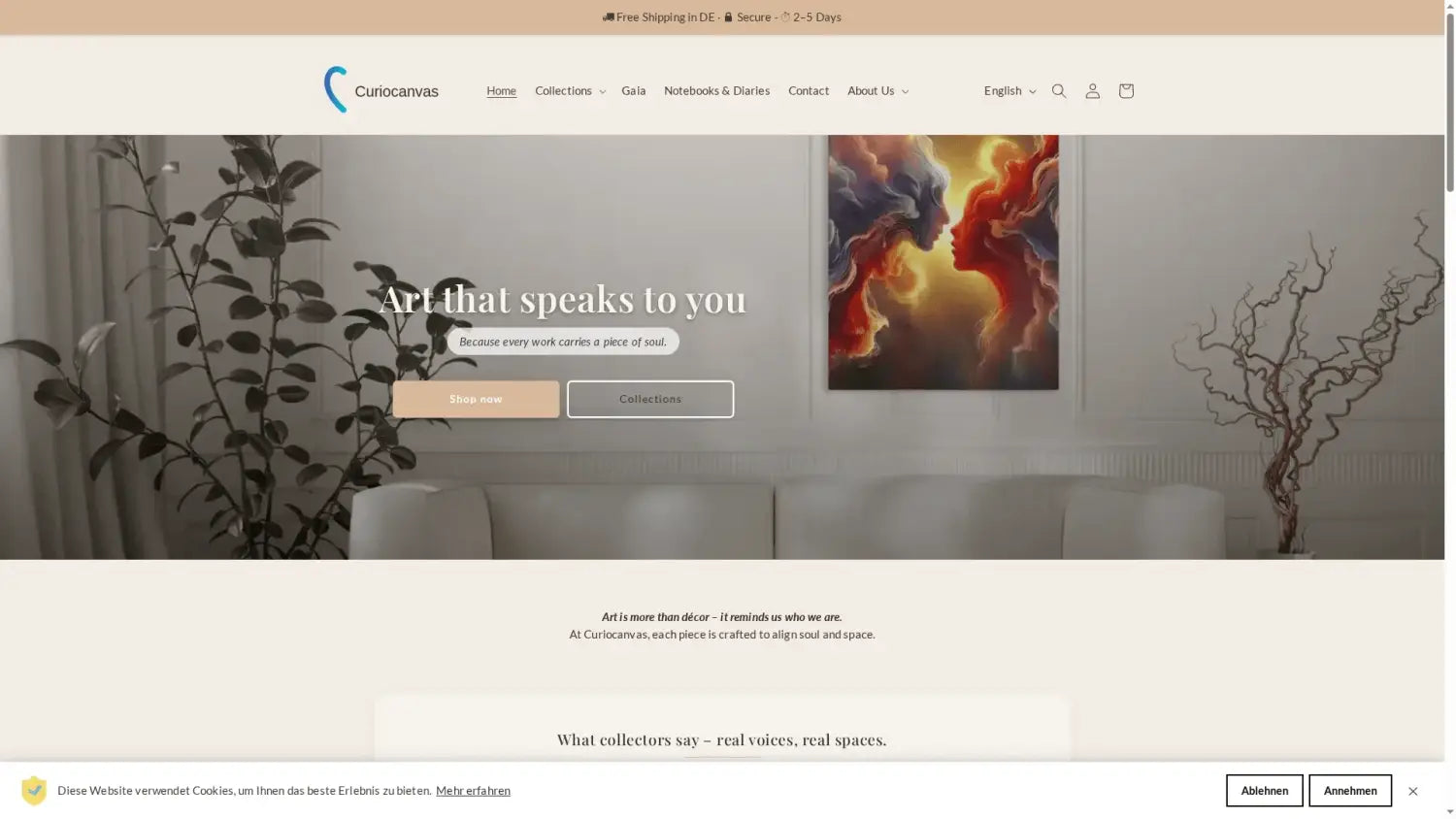
Immerse yourself in our Wall Art Gallery Flames Kisses Time and Compass – Curiocanvas and discover masterpieces that translate moments and mythology into high-quality canvas and poster prints. Your search for visual poetry and a meaningful atmosphere becomes reality here. Or let yourself be inspired by Artwork as a mirror of your soul. Discover the Curiocanvas Homepage and experience art that reflects emotions and transforms spaces. Start your journey now to wall decor that tells stories and touches the soul at curiocanvas.de .
Frequently Asked Questions
How can I create poetic works of art myself?
To create your own poetic artwork, start by choosing a theme or emotion you want to express. Experiment with different techniques such as calligraphy, collage, or haiku to combine your ideas visually and textually.
What materials do I need for poetic collages?
To create poetic collages, you will first need various text and image fragments that you find appealing. Additionally, use paper, scissors, glue, and paints to creatively design your collage and add your personal touch.
How do I choose suitable quotes for my quote art?
Choose quotes that have special meaning for you or evoke emotions. Consider how these quotes can be integrated into your artistic presentation to create a harmonious connection between text and visual design.
What are the basic steps to creating a haiku artwork?
To create a haiku, first choose a unique moment or natural phenomenon you wish to capture. Reduce your description to the essential 17 syllables and add a minimalist visual component to reinforce the message.
How can I use emotional color harmonies in my designs?
To use emotional color harmonies in your designs, choose a basic mood you want to convey. Then combine complementary colors and ensure that the color selection reinforces the desired atmosphere in the room.
How can I find inspiration for my art through mythological symbols?
To find inspiration through mythological symbols, research various mythological motifs that appeal to you. Interpret these stories in a modern way and combine them with your personal experiences to create deeper layers of meaning in your art.